


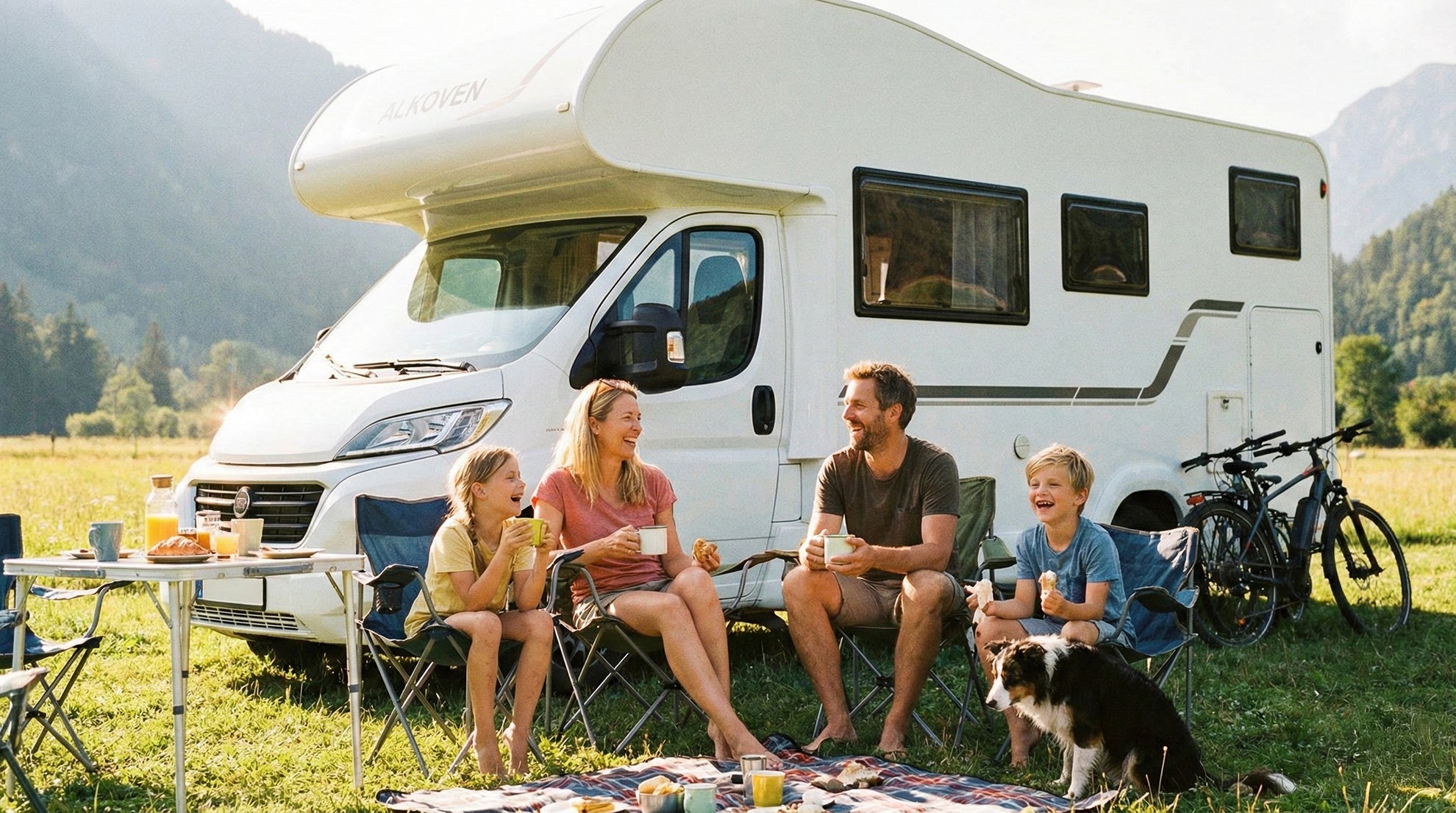
Vanlife with children is the dream of many families: waking up together in the campervan, discovering new places, and experiencing real adventures. But before it starts, many questions arise.
Which van suits you? How do you organize sleeping places and storage? And how do you solve the annoying toilet issue on the road? In this guide, you get all the answers you need to start mobile family life.
What is vanlife with children and what prerequisites do you need?
In vanlife with children, you live and travel as a family in a converted van or motorhome. Most families are on the road at least 30 days a year, some even permanently. 78 percent use vehicles between 6 and 7 meters in length, as this offers enough living space for 3 to 4 people without the van becoming too bulky.
The big difference compared to classic vanlife as a couple: With children, you need much more planning. More sleeping places, more storage space, more safety. Children want to play, romp, and have their own needs. Spontaneously setting off and seeing what happens? With little ones, that only works to a limited extent.
In return, you get something much more valuable: intense time together, adventures as a family, and memories that last a lifetime. Everyday life in the van follows a clear rhythm. Breakfast with a view of the lake, a hike in the morning, playing on the beach in the afternoon, cooking together in the evening. All of this on 12 square meters, because that is the average living space you have available.
Before you can enjoy this everyday life, an important decision awaits: Which vehicle will be your rolling home?
Which campervan is best suited for vanlife with children?
The right campervan is the foundation for relaxed vanlife with children. For a family of four, the vehicle should be at least 6 meters long and offer 4 sleeping places.
Pop-up roof models are particularly clever because they create 2 additional beds without making the van look too cluttered during the day. In terms of standing height, a high roof with 2.1 meters makes life significantly more comfortable than the 1.9 meters of standard roofs.
When choosing the vehicle, you basically have the following three options.
- Panel vans
- Fully integrated motorhomes
- Alcove models
- Panel vans: Panel vans like the Mercedes Sprinter or Fiat Ducato are compact, agile, and fit in normal parking spaces. They cost between 65,000 and 90,000 euros and are perfect for families with smaller children.
- Fully integrated motorhomes: Fully integrated motorhomes offer more comfort and living space but are bulkier and more expensive.
- Alcove models: Alcove models have a fixed bed above the driver's cab, which is especially practical because you don’t have to convert it in the evening.
The equipment makes the difference in everyday life. Bike racks for 4 wheels cost between 800 and 1200 euros but are worth their weight in gold if you want to be active on the road. Roof boxes increase storage space by 300 to 500 liters. And a permanently installed toilet? That saves you time and nerves every day.
Once the vehicle is found, the next big question comes: Where do actually all sleep?

How do you optimally organize sleeping places for children in the van?
Good sleep is the basis for relaxed travel days, this applies to children just as much as to adults. In the van, each person needs their own sleeping place with at least 1.80 meters length and 0.70 meters width. Sounds like a lot of space? It is. That’s why 89 percent of vanlife families rely on clever solutions like bunk beds or pop-up roofs.
Bunk beds in the rear of the van are the classic for two children. They require about 1.40 meters width and 1.80 meters length per level and make optimal use of the room height. The upper bed definitely needs a fall protection with at least 25 centimeters height. The lower level can often be used as a seating area during the day.
Pop-up roofs are the most space-saving option for additional sleeping places. They increase the room height from 1.9 to 2.7 meters and offer a lying surface of 2.00 by 0.80 meters. That is enough for 2 adults or 2 to 3 children. The setup takes only 30 seconds, and during the day you have full standing height again.
A tip from practice: Fixed sleeping place assignments work better than negotiating at night. Each child gets their own bed, which creates structure and avoids quarrels.
The sleeping places are an important point settled. But when vanlife with children, safety comes first.
What safety equipment is indispensable when vanlife with children?
Your children’s safety is the top priority in vanlife, there’s no question about it. A well-equipped van protects your family from accidents and emergencies. The basic equipment consists of a CO detector, smoke detector, and fire extinguisher. This is not a recommendation, it’s mandatory.
- CO detector: CO detectors detect the odorless, deadly carbon monoxide that can arise from faulty gas systems or running engines. They react at a concentration of 30 ppm within 120 minutes and warn you in time. Installation is near sleeping areas at about 1.5 meters height. Smoke detectors trigger at 0.15 dB/m smoke density and give you valuable seconds of warning in case of fire.
- Fire extinguisher: A fire extinguisher with 2 kg ABC powder covers all relevant fire classes and should be within easy reach near the kitchen. Make sure older children also know where it is and how to use it.
- Child seats: Child seats in the van must comply with the ECE R44 or i-Size standard. Isofix mounts offer the safest attachment. For children under 12 years or 1.50 meters tall, they are mandatory in Germany. Added to that are fall protection on bunk beds and child locks on cabinets and drawers.
The safety equipment is set, now comes the practical question: How do you distribute the limited space so that everyone is happy?

How do you divide the limited space in the van to suit a family?
12 square meters for 4 people sounds like a challenge. And it is. But with the right layout, your van will still be a cozy home. The trick lies in clear zoning: sleeping area, living area, kitchen, and sanitation each need their fixed place.
Partition curtains are real secret weapons. They create up to 4 separate areas without wasting space. Open during the day, closed in the evening, and everyone has their retreat. For teenagers in the van, separated sleeping areas are especially important.
The storage space under bench seats offers 200 to 400 liters of volume per bench, which is more than you think. Added to that are hanging cabinets, storage compartments, and net pockets on the walls. Each family member should get 2 to 3 personal compartments of 20 to 30 liters each. That sounds like little, but it’s enough for personal items, toys, and clothes.
Personal space is more important than many think. A personal storage compartment, a small shelf by the bed, maybe a wall pocket for favorite things. This gives children a feeling of home and significantly reduces conflicts over territories.
Pop-up roofs not only increase sleeping spaces but also the sense of space. The additional height from 1.9 to 2.7 meters makes the van airier and less cramped.
The layout is set, but what about the budget? What does vanlife with kids actually cost?
What does vanlife with children really cost?
Let’s be honest: vanlife with children isn’t a cheap vacation, at least not initially. A family-friendly van costs between €65,000 and €120,000, depending on model and equipment. 67 percent of families invest a total of €80,000 to €100,000. Added to that is child safety equipment costing €2,000 to €4,000.
Ongoing costs range between €2,200 and €3,800 per month. This consists of fuel (€400 to €800), campsites (€600 to €1,500 with daily use), groceries (€600 to €1,000 for 4 people), insurance and taxes (€150 to €300), as well as maintenance and repairs (€100 to €300).
Sounds like a lot? Compare it to: rent, utilities, two cars, daycare, leisure activities. Many families find that vanlife isn’t more expensive than stationary living, sometimes even cheaper. Especially if you often camp free instead of on expensive campsites.
Hidden costs still exist. Gas refills for heating and cooking (€50 to €100 monthly), toll fees, spare parts, unforeseen repairs. An emergency fund of €2,000 to €3,000 should always be available.
Money is one thing, but living closely together brings other challenges. How do you keep the mood good when everyone is packed together?
How do you avoid conflicts between children in tight spaces?
Siblings in 12 square meters can be either fantastic or a total disaster. The good news: with the right strategies, conflicts decrease significantly. Studies show that fixed daily routines reduce conflict potential by up to 43 percent. Children need structure, especially when the environment constantly changes.
Fixed times for meals, play, and rest structure the day. That sounds restrictive but is actually the opposite: within this structure, children can move freely because they know what comes next. Daily life in the van works better with clear routines than with constant improvisation.
Movement is the best conflict killer. Plan at least 2 hours of outdoor activities daily. Romping, running, climbing—children need all that, and the van can’t provide it. On long drives, 15-minute breaks every 2 hours are legally required; use them actively.
Separate areas for each child reduce disputes over territories. A personal storage compartment, a fixed sleeping place, clear seating spots. Headphones are worth their weight in gold so each child can pursue their own activities without disturbing the others.
Statistically, conflicts increase by 23 percent with children over 10 years old. This is due to the growing need for privacy and independence. Here, retreat options and enough time outside the van help the most.
Harmony on board also depends on the campsite. Which sites are truly family-friendly?
Which campsites are best suited for families?
Not every campsite is suitable for vanlife with children. The differences are enormous, from carelessly asphalted pitches to family paradises with pools and entertainment. What should you pay attention to?
Family-friendly campsites have pitches starting at 80 square meters. That sounds like a lot, but with an awning, camping table, and playing children, it quickly gets tight. The sanitary facilities with changing rooms are a maximum of 100 meters away, important for nighttime toilet visits with small children. 78 percent of good family pitches have playgrounds with TÜV-certified equipment.
The location of the pitch makes the difference. Sites near the sanitary facilities shorten nighttime trips, shady spots are indispensable in summer, edge locations offer more peace. Many campsites offer Wi-Fi, often indispensable for homeschooling and entertainment.
There are big differences in costs. Simple sites cost 15 to 25 euros per night, family resorts with pools and entertainment reach 40 to 60 euros. Washing machines cost 3 to 5 euros per wash, an important item for families with children.
Free camping is the free alternative. In many European countries, overnight stays in the van outside of campsites are allowed. With children, this requires more planning because you need a functioning toilet on board and enough water. But more on that later.
One of the biggest hurdles for longer vanlife with children is compulsory schooling. How do you solve this legally correctly?
How do you solve the problem of compulsory schooling with vanlife?
Compulsory schooling is the biggest obstacle for many families on the way to vanlife. In Germany, it applies strictly to all children between 6 and 18 years old. Just driving off and hoping no one notices? Not a good idea.
However, there are legal solutions. For shorter trips, you can apply for a leave of absence from school. Up to 6 weeks are possible in many federal states, sometimes even more. A good reason and early request are important.
For longer vanlife, there is the World School. It is a state-recognized distance school for traveling families. Lessons take place online and with learning materials, parents accompany the learning and send in assignments for review. Costs range from 200 to 400 euros per month per child.
Homeschooling is legal in 12 EU countries, including Portugal, France, and Denmark. Some families register their residence in one of these countries and teach their children themselves. This requires preparation and knowledge of the respective requirements.
The easiest solution? Traveling during school holidays. 13 weeks per year offer plenty of time for vanlife. With bridge days and extended weekends, this can be extended even further.
34 percent of vanlife families also use museum and nature learning programs. The world is the best classroom, and children often learn more on the road than at school.
Compulsory schooling can be managed, but what do you do during days of continuous rain?
Which strategies help in bad weather?
Rainy days in the van are the ultimate test for every family. Four people in 12 square meters, continuous rain outside, rising tension inside. It doesn’t have to be that way; with the right preparation, rainy days can even be cozy.
The golden rule: Always have 20 to 30 different indoor activities ready for at least 7 rainy days. Games, books, craft materials, audiobooks, podcasts. Pack more than you think, because after the third rainy day everything has been played through three times.
Blackout curtains are multitaskers. They cost 150 to 300 euros, reduce light entry by 95 percent, and create a cozy atmosphere when it rains. In the evening they enable movie nights, during the day they protect against heat. A worthwhile investment.
Ventilation is often neglected in bad weather. Closed windows and wet clothes quickly create a stuffy, humid climate. Roof vents and ventilation grilles provide fresh air without letting rain in. Insect screens on the windows (200 to 400 euros for 4 windows) allow ventilation even in summer.
During several days of continuous rain, alternative accommodation is sometimes the best solution. Holiday apartments, hostels, or cabins at campsites cost 50 to 80 euros per day and offer more space and variety. This is not a failure but smart planning.
Different age groups have different needs, also when it comes to activities. How do you keep babies, schoolchildren, and teenagers entertained at the same time?
How do you keep children of different age groups busy?
Vanlife with children often means: different age groups, different needs. What a three-year-old loves bores a teenager to death. The solution lies in age-appropriate planning.
Babies from 0 to 2 years need safe toys without small parts under 3 cm. 15 to 20 toys are enough; more won’t be used anyway. Grasping toys, cloth books, rattles, all easy to clean and space-saving. A safe sleeping place in the baby car seat or travel cot is indispensable. Diaper changes work on the folded-down bed or a mobile changing pad.
Toddlers between 3 and 6 years want to explore and be creative. Art supplies, modeling clay, simple puzzles, and picture books fit into small boxes. Audiobooks shorten long trips. A portable potty with about 1.2 liters capacity makes spontaneous toilet visits on the go easier when there is no proper toilet nearby.
Schoolchildren aged 7 to 12 can already read and play independently. Tablets with learning apps and games are practical companions, 3 to 4 hours of screen time per day is realistic. Card games and compact board games are suitable for shared evenings. Schoolwork can be done with a laptop and stable Wi-Fi.
Teenagers from 13 years old especially need one thing: privacy and contact with the outside world. Headphones, smartphone, and 2 to 3 hours of stable internet daily are indispensable. Their own retreat areas in the van reduce conflicts with younger siblings. Give them space, and vanlife works even with teenagers.
One thing connects all age groups: going to the toilet. And that is a topic of its own with vanlife and children.
How do you solve the toilet problem with vanlife and children?
Let’s be honest: What is the biggest challenge with vanlife with children? Right, the toilet. Children need to go often and spontaneously, can’t wait forever, and often announce the need at the worst possible moment. A good toilet solution in the van is therefore not a luxury but a necessity.
Chemical toilets are widespread but not ideal for families. The chemicals smell unpleasant and are harmful to the environment. Disposal only works at special stations, which you won’t find everywhere. With frequent use by 4 people, the tank fills up quickly. At night, using a stinky plastic bucket? That doesn’t have to be.
Composting toilets are the smart alternative. They separate urine and solids, so no ammonia forms and thus no unpleasant odor. Disposal is flexible: solids go into regular trash, urine can be diluted and used as fertilizer or taken to disposal stations.
For vanlife with children, composting toilets offer clear advantages. They work without water and without chemicals. Cleaning is simple and child-safe. The compact design fits even in small vans. And most importantly: children can use them independently and safely.
A permanently installed toilet in the van saves time and nerves every day. No searching for public restrooms, no nighttime trips to sanitary facilities, no stress with spontaneous needs. Especially when free camping, a good toilet solution is indispensable.
With all the comfort, you must not forget one thing: In an emergency, every second counts. What does your evacuation plan look like?
What do you do in an emergency? Evacuation plan for families
Nobody likes to talk about emergencies, but every family should be prepared. A van is a small space with limited escape routes. Fire, gas leaks, or accidents can quickly become dangerous. A clear evacuation plan gives everyone security.
The most important rule: Evacuation from the van must take no more than 30 seconds. This only works if everyone knows their escape route. The van has at least 2 exits, a side door and a rear door. Explain both routes to your children and practice them regularly.
An emergency hammer allows you to break the windows if doors are blocked. It shatters the glass in 3 to 5 strikes and hangs within easy reach near the sleeping areas. Older children should also know where it is and how to use it.
The meeting point is 50 meters away from the van, always in a safe direction away from the vehicle. In case of fire or gas leak, distance is life-saving. Make the meeting point clear to all family members and practice it regularly.
Important documents, cash, and medications are ready in a waterproof emergency bag, weighing about 500 grams. This bag has its fixed place, and in an emergency, one adult grabs it while the other takes the children outside.
Plan 15 minutes monthly for emergency drills. Children learn playfully how to react in an emergency, and the knowledge solidifies over time. Better to practice once too often than once too little.
You now know everything about vehicle choice, sleeping places, safety, costs, and everyday life in the van. Only the perfect toilet solution for your family is missing.
BioTioo: The perfect toilet solution for vanlife with kids
If there is one thing that really makes vanlife with kids more relaxed, it is a good toilet. Our separation toilets from BioTioo are made exactly for that: comfortable, hygienic, low odor, and completely chemical-free.
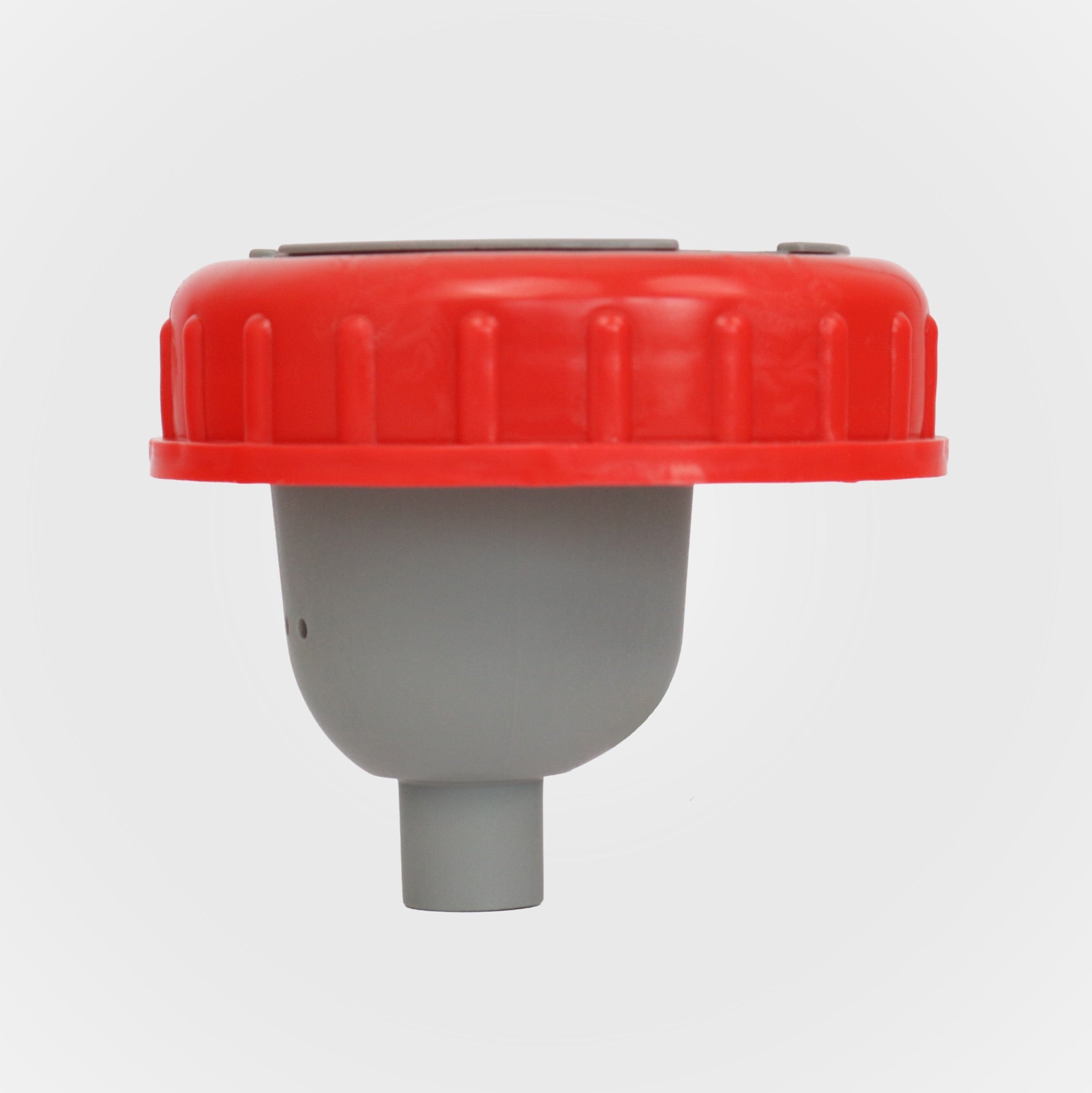
The principle is simple and ingenious at the same time. A clever separation system separates urine and solids from each other. The urine flows into a separate canister, the solids end up in the collection container with litter. Without contact between the two, no ammonia is produced, and thus no unpleasant odor. It works so reliably that you can open the toilet even after days without wrinkling your nose.
For families, BioTioo offers decisive advantages. The robust stainless steel construction withstands years of use, even if children are not always gentle with it. The smooth surface is easy to clean, no harsh chemicals needed. The compact design fits in any van, even smaller panel vans.
Installation is straightforward: no water, no electricity, no sewage system needed. Disposal is flexible, solids go into the residual waste, urine diluted as fertilizer or at stations. No searching for special disposal stations, no dependence on campsite infrastructure.
BioTioo offers you the perfect toilet solution for vanlife families:
- BioTioo 2.0: The comfortable successor to BioTioo 1.0 with an improved seat surface and modern hinge. Even easier to clean and ideal for families who value comfort.
With our BioTioo separation toilets, your vanlife with kids becomes even more relaxed. No searching for disposal stations, no unpleasant odors, no chemicals in the van. Instead: a toilet solution that simply works. For more freedom, more flexibility, and more shared adventures.