


It doesn’t always have to be a campsite with full infrastructure: When you make your caravan self-sufficient, you become much more independent from power outlets, sanitary buildings, and fixed pitches.
Self-sufficiency means: Your system of electricity, water, gas, and toilet works so well that you can stay off-grid for several days or even several weeks in a row, with a caravan that feels like a small home. Making your own caravan self-sufficient – here’s how.
What does self-sufficiency mean in the motorhome?
Self-sufficiency in the caravan means: Your camper works without a fixed power outlet, without a direct connection to the power grid, and without heavy use of the campsite infrastructure.
So you are free to stay at parking spots, farms, or in nature and still have electricity, water, a working heater, light, and a toilet on board. You don’t have to give up anything because you are your own provider.
Important areas of self-sufficiency are:
- Power supply through solar cells, battery, or a charger
- Water supply through water tanks, water pumps, and an all-around smart water system
- Heating and gas in the form of, for example, gas bottles and a gas heater
- Sanitary and toilet through, for example, a chemical toilet or a composting toilet
- Wastewater and grey water through grey water tank and disposal at disposal stations
Being self-sufficient does not directly mean managing forever without infrastructure. Rather, self-sufficient camping is about supplying yourself for several days in a row to enjoy a very own piece of freedom and independence.

Planning around energy needs, water, and budget: The first step
Before you simply screw a solar system onto the roof, it’s worth taking a look at your actual usage behavior. Self-sufficiency is a small project – and good planning will save you a lot of money and nerves later.
Answer, among other things, these questions:
- Which devices do you use in your daily life?
- How long do you use these devices daily?
- How often do you shower?
- How much water do you use for cooking, washing up, and brushing your teeth?
- How many people are traveling with you and how long do you want to manage without a campsite?
From all these answers, you can then derive your energy needs and the required capacity for fresh water, grey water, and wastewater tanks. At the same time, of course, the budget available to you also plays a role: A solar system with solar modules, lithium batteries, inverter, solar charge controller, charge booster, and a new toilet are sometimes more expensive investments.
But these are usually worth it because, in return, you gain long-term independence while camping and especially on routes with few pitches, you gain more freedom.
Self-sufficient power supply: Everything about the solar system, battery, and chargers
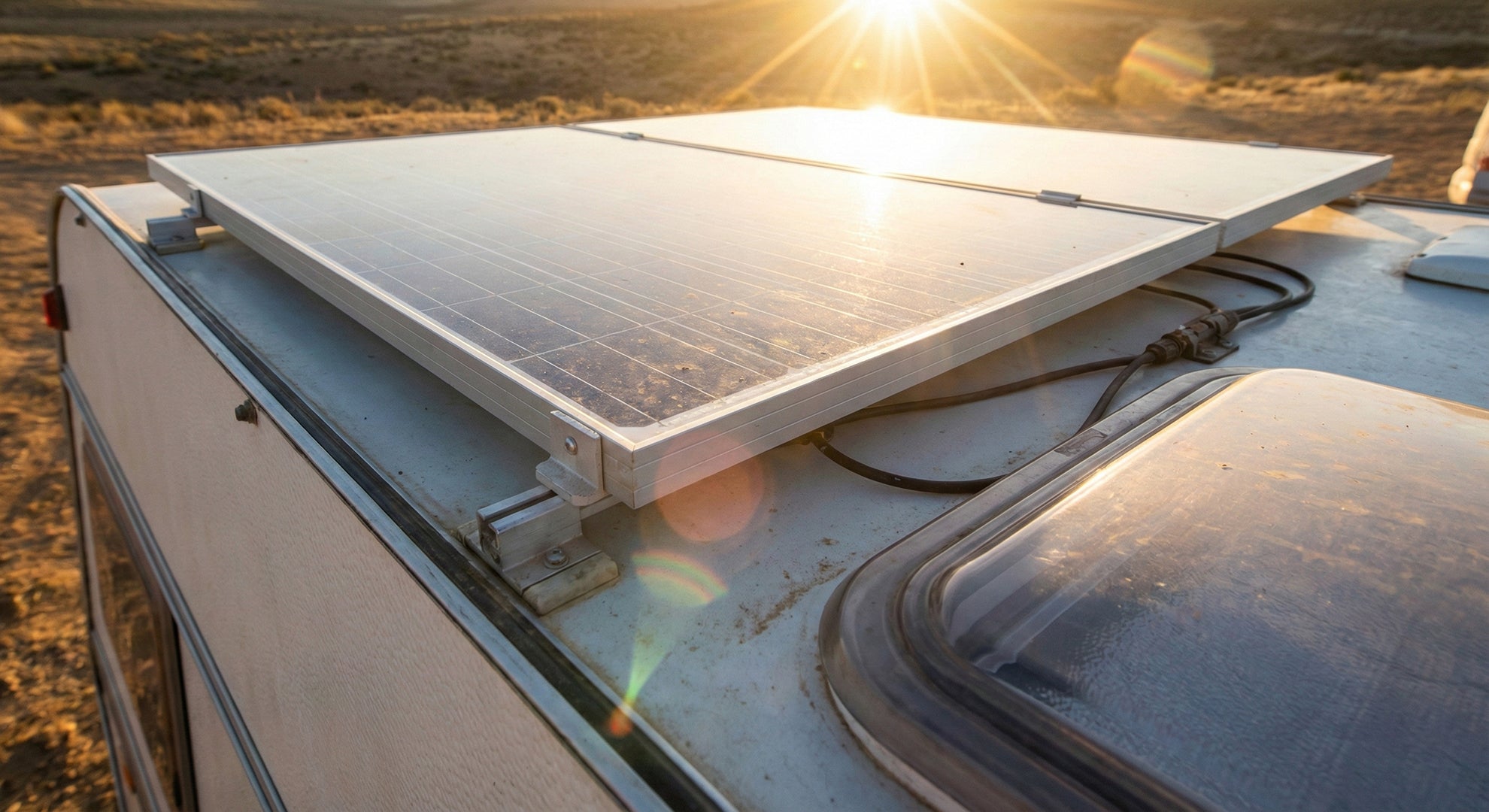
The basis for a self-sufficient caravan is usually a solar system with solar panels on the roof. The solar modules produce electricity entirely from solar energy. That means they charge your onboard battery during the day and cover your daily energy needs without you having to do anything except stand in the sun.
You have different options:
- Fixed solar panels mounted on the roof or in the drawbar box.
- Mobile solar suitcases that you set up and optimally align to the sun.
By the way, between the solar panels and the battery there is a solar charge controller that regulates the voltage and ensures, among other things, that your batteries are always charged as efficiently as possible. A solid solar charge controller combined with a clean, competent installation is therefore crucial for a reliable power supply.
The onboard battery – The heart of your energy supply
The onboard battery is the central energy storage in your caravan. It supplies you with power when you don't have a mains connection. There are different battery types that differ significantly in price, performance, and lifespan:
AGM batteries
They are comparatively inexpensive and robust, but also heavy and not very powerful. Their usable capacity is lower than that of lithium batteries, and they usually do not withstand many charge cycles.
Lithium-batteries
Lithium batteries, especially LiFePO4 cells, are more modern and significantly lighter and more powerful. They can be discharged deeper, deliver more energy at the same size than AGM batteries, and also score with a very long service life. Additionally, they charge quite quickly.
For a self-sufficient caravan, a lithium battery is usually the best choice. It provides you with enough energy for longer standstills and works reliably even at changing temperatures. This way, you can live just as comfortably on the road as at the campsite.
Charging on the go – This is how your onboard battery stays full
For your onboard battery to supply you with power, it must be regularly recharged – and this can be done in several ways, not just via the solar system.
Charge booster and Alternator
While driving, the charge booster charges the onboard battery via the alternator of the towing vehicle, even if the alternator voltage fluctuates. A separation relay is important to prevent the car's starter battery from discharging.
mains power at Campsite
If you are at a CEE socket, you can charge your battery with 230 V alternating current using a suitable charging cable and power supply. This is especially practical on those days when the sun doesn't shine or you stay in one place for a longer time.
Alternative Energy sources
Power stations, generators, or fuel cells are a good emergency solution, both for winter camping and bad weather with high power demand.
The probably best combination for most campers is: solar system + lithium battery + charge booster + shore power connection. This makes you independent at almost every pitch and you never run out of energy even without a socket.
Electricity in everyday life – 12 V, inverter, and typical consumers
In self-sufficient operation, most of your devices such as LED lighting, water pumps, the fan, internet router, and USB chargers run on 12 V direct current. For classic household appliances like the coffee machine or TV, you therefore need an inverter: it converts the battery voltage into household current.
And to make your electricity last, there are a few simple measures with which you can significantly increase your energy efficiency:
- Use LED lamps instead of conventional bulbs.
- Rely on energy-efficient cooling systems like compressor or absorber refrigerators in Eco mode.
- Use 230 V devices consciously, and only when enough energy is available.
This way, you live especially comfortably and energy-efficiently in your camper – and the environment benefits as well.
This is how you noticeably extend your self-sufficient stand times
Self-sufficient camping means freedom – at least when water, energy, and comfort are cleverly organized. Because only through a well-thought-out supply of electricity, gas, and water do you remain independent while camping and live as you want.
Water supply and wastewater – fresh water, grey water, and disposal
Water is indispensable when camping, yet consumption can be surprisingly well planned and even partially reduced. A prime example: with a well-planned water system including fresh and grey water tanks, you don’t have to go to the water source every day.
Depending on the length of the trip and the number of people, the capacity of the fresh water tank is usually between 50 and 100 liters. Additionally, you can expand your supply with jerry cans or extra containers. A small water pump conveniently delivers fresh water to the sink, shower, or toilet – and afterwards, the used water goes into the grey water tank. This tank is either fixed or mobile and should only be emptied by you at official discharge stations.
Our tip: Clean the tanks regularly and use water filters or treatment systems if needed. This keeps the fresh water cleaner for longer, allowing you to enjoy your camping life carefree for several days.
Gas supply, heating, and cooking in the self-sufficient caravan
In the caravan, gas is the most reliable energy source: it usually powers the heating, the stove, and often the refrigerator as well.
The gas bottles are usually located in the drawbar or storage box and are connected to the devices via pipes. Through them, you can heat, cook, and keep food cool even without a power connection. Alternatively, sometimes diesel heaters or other fuels can also be used. The disadvantage here, however, is usually the significantly higher energy demand.
Sanitary and toilet – chemical toilet or composting toilet as a sustainable solution
Hardly any topic is discussed as intensively among campers as the toilet question. Many caravans come factory-equipped with a chemical toilet, which basically works reliably but is often impractical in practice.
The reason is simple: it requires chemical additives and is quite laborious to empty. So when emptying, you are always tied to disposal stations since the chemicals may not be disposed of anywhere else. Additionally, handling the waste tank is quite unpleasant, especially during longer stays.
A modern and sustainable alternative to the complex and environmentally harmful chemical toilet is the composting toilet. Here, urine and solids are collected separately: urine flows into a separate canister, while solids end up in a container with litter.
This convinces threefold, as the method saves water, prevents unpleasant odors, and reduces chemical use to zero. This makes you much more flexible since you are no longer dependent on disposal times. For campers who value independence and sustainability, buying a composting toilet is therefore one of the best solutions for autonomous living.
Advantages of composting toilets at a glance
- no additional water consumption for flushing water
- significantly less odor due to separation of liquid and solid waste
- more flexible disposal
- less dependence on emptying times and sewage connections

Practical tips: How to extend your autonomous standby times
To turn theory into real self-sufficiency, a few simple everyday habits help:
Save electricity
- Use LED lamps for lighting
- Really turn off devices instead of leaving them in standby mode
- Prefer using a laptop or tablet instead of the big TV
- Operate coffee machines and similar devices less often via inverter
Save water
- Keep water consumption consciously in view
- Take short showers instead of long wellness sessions
- Wash dishes in the sink with little rinse water
- Use the gas heater sensibly and insulate the caravan well
- use additional blankets and rugs in winter temperatures
Toilet and supplies
- Operate the composting toilet with the right amount of litter
- Plan emptying times for urine canister and solid waste container
- Take enough supplies of food, water, toilet paper, and gas bottles
With these practical tips, you can noticeably extend the stand times of your caravan – and won’t have to drive to the next campsite every two days.
Make your caravan self-sufficient – with BioTioo
Making a caravan self-sufficient ultimately means reclaiming a piece of true freedom. This includes, besides reliable power and water supply, especially the right toilet solution – and you’ll find that with BioTioo. Our chemical-free composting toilets were specially developed for campers, caravans, and motorhomes who want to camp sustainably and independently.
These are your advantages with BioTioo’s composting toilets:
- completely chemical-free – ideal if you want to leave toilet chemicals and fecal tank emptying behind
- no water consumption when using the toilet
- clean separation of urine and solids and less odor
- easy disposal in residual waste or – depending on regulations – via compost
- compact design for campers, vans, bench seats, or the wet room in the caravan
Together with a well-planned solar system, lithium batteries, and a clever water system, BioTioo becomes the perfect building block to make your caravan truly self-sufficient.
But don’t worry: You don’t have to retrofit everything at once. Start with what benefits you the most – for example, with a solar system and a composting toilet – and then expand your system step by step. This way, your caravan will gradually become a strong base for your next trips.