



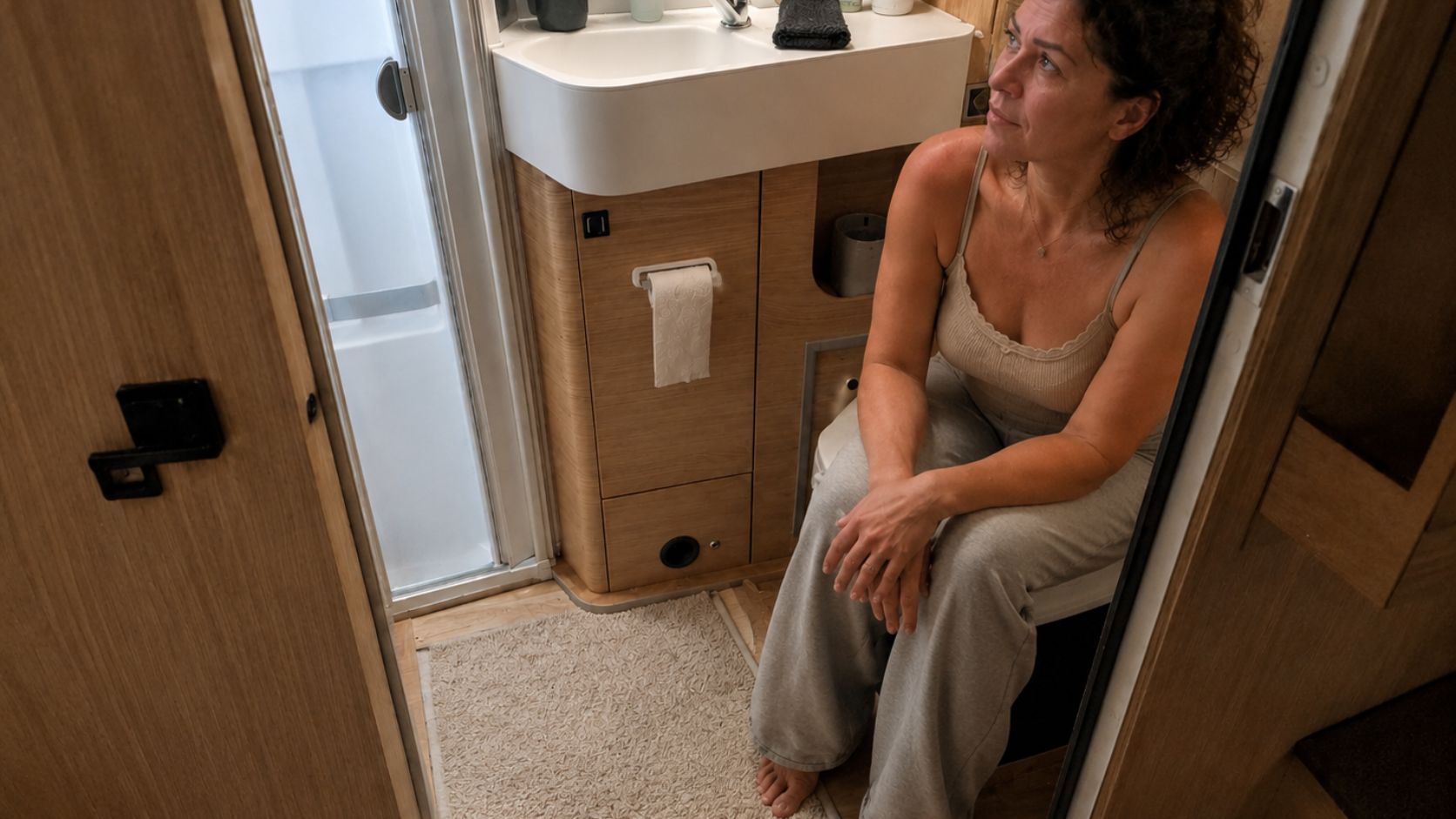
A forum reader wrote to a German manufacturer in autumn 2025 under a women's urine-diverting toilet guide: "It's really a matter of luck for a woman to get the urine to the right place, especially when you have to go half-asleep at night." The manufacturer's response did not solve the problem. This exact gap is closed by this page, with anatomy, two studies, and three design schools between which women can choose in practice.
What follows below is a frame shift: away from "women must aim better" toward "the toilet must forgive small separation errors." This shift is not soft; it is measurable. Two studies from sanitation research show why, and three design schools in the market respond differently. What helps in everyday life, what science says, and which design decisions truly relieve women, step by step.
What sitting position really means for a woman on the urine-diverting toilet
Sitting position here does not mean a rigid posture but three adjustment points that together determine separation efficiency: upright sitting, gentle forward and backward sliding of the hips, and the leg angle as a fine correction. Once understood, separation is no longer just a matter of concentration but a geometric task where two-thirds of the solution lies outside the sitting posture: in the bowl geometry and pre-composting.
Anatomically, one number counts: the female urethra is clearly shorter at three to five centimeters compared to the male, which is fifteen to twenty centimeters long. This means the stream exits more directed downward-forward and often runs exactly into the fall line of the solid waste opening when sitting. Those unfamiliar with the mechanics of the dry urine-diverting toilet can find it in the complete women's guide to the urine-diverting toilet. From the next section, it’s about depth.
How female anatomy and the separation insert interact – and what science says
The sitting position for women on the dry urine-diverting toilet is anatomically and structurally explainable, and these two aspects can also be addressed separately. Two studies show the anatomical side, three adjustment points in sitting technique cover the behavioral side, and a clear tolerance limit makes everyday life with small separation errors more relaxed. Women who choose a urine-diverting toilet without distinguishing these three levels mix anatomy, behavior, and product design, and ultimately do not get closer to the real issue.
What the Eawag study reveals about the female urine stream
The Swiss water research institute Eawag has studied the gender-specific use of urine-separating toilets and found three findings that are practically relevant for every woman. First: women show a significantly greater variation in body posture and urine impact angle compared to men, not because they sit imprecisely, but because anatomy and culturally learned sitting posture are more diffuse. Second: the female urine stream sometimes falls into the fall line of the seat, i.e., into the area where the solid waste opening is located in a separation toilet. Third: the angle range is larger than in men, increasing the risk that urine enters the wrong compartment or splashes beyond the separator.
Eawag additionally emphasizes that women fundamentally need more space, more privacy, and more time for use, and that these requirements increase during menstruation, older age, and disabilities. From this research situation follows a constructive consequence: manufacturers who want to make their dry separation toilet suitable for women must design the separation insert with a larger opening, higher separation ridge, or active mixing against the anatomy, not with it. Those who build otherwise build precise geometry for one gender and hope for discipline from the other. This is the frame shift that the market has slowly been undergoing in recent years.
What the RTI study shows about real everyday life
A second study by the US research institute RTI International with 41 female users of a urine-separating squat-pan toilet showed an even more practical result: A significant proportion of female users in field studies showed behaviors that reduce separation performance. Specifically, this means: incorrect aiming, backward positioning, only partially lowering when sitting, occasional flushing with water during urination.
This is not a moral failure, it is the realistic range of everyday behavior: people are tired, in a hurry, distracted, or simply inexperienced. The strategic implication is greater than the number: even if a system theoretically works cleanly, it regularly loses performance in normal usage behavior. The right question for manufacturers is therefore not "Do women do it correctly enough?", but "Is the product fault-tolerant enough?". This frame shift is not soft. It is the direct conclusion from the RTI data, supported by Eawag's geometry findings – and it separates toilets that are practical for women in everyday use from those that only look good in the manual.
The three adjustment screws of seating technology
If you still want to adjust the sitting technique (and it’s worth it because the adjustment really only takes a few tries), the DACH camper community offers three clear adjustments. First, an upright seat, not leaning back. As soon as the upper body tilts backward, the stream shifts into the fall line of the solid waste opening. Sitting upright doesn’t mean rigid, but feeling about one centimeter higher than usual; this mechanically realigns the stream forward.
Secondly, a gentle forward-backward movement of the hips: slide slightly forward for a small business so that the urine outlet is above the urine area; slide slightly back for a big business so that the stool lands in the solid waste area. This movement is small (one to two centimeters) and becomes reflexive after a few uses. Thirdly, the leg angle as a fine adjustment if the first two adjustments are not enough. Slightly opening or closing the knees changes the geometry of the stream by a few degrees and is usually enough as a fine-tuning. For a very strong stream or unusual body posture, the leg angle is the quickest solution; it costs no time and doesn’t disrupt movement.
A vanlife camper sums up the adjustment period in a three-year experience report: “After the first two to three uses, it’s stored in muscle memory.” This observation matches all other reports. The conscious sitting technique is a short exercise, not a lifelong training. If you invest three tries, you automatically have the sitting posture afterwards, even if concentration wanes.
Why drops are not a problem – if the product forgives them
Small mistakes still happen even after practicing sitting technique. If you’re tired at night, older, in a hurry, or simply sitting in a tilted camper, you won’t be perfect. A few drops of urine in the solid waste are uncritical, and that is the most important reassurance in everyday life. “If you lean back further as a woman and some drops of urine end up in the solid waste container, it’s not a problem. In that case, just use a little more litter to bind the moisture,” writes a German dry toilet manufacturer in their own guide.
The rule is clear: small amounts are absorbed by the coconut fibers, the stirrer distributes them during the next flush, and the fan dries everything. Only consistently large amounts are a problem; then it’s worth taking a closer look at the height of the separating ridge or the sitting posture in detail. Two components mainly determine how tolerant the system is: the size of the solid waste opening and the height of the separating ridge. A larger opening allows freedom of movement without the need for precision. A high separating ridge prevents urine from running into the wrong area when leaning back slightly or when the camper is tilted. Additionally, the fan actively removes residual moisture, the third adjustment for tolerance.
A female camper in a long-term report describes the difference between generous and narrow openings: “The opening, for example, of a *Name redacted* is at most half as large, which means there is hardly any freedom regarding sitting position there.” Larger is not automatically better here, but tends to be: more opening gives freedom of movement, a high separation ridge provides safety against backflow, and the fan actively removes residual moisture. How different manufacturers implement these tolerance adjustment screws differently is shown in the next section with the three-schools comparison.
The sitting technique in everyday life—and what changes in edge cases
Mechanics plus sitting technique provide the theory. In everyday life, the interplay with concrete life situations decides: night, period, travel, guests.
Three steps, two to three uses, then automatic
The routine is short and mechanically clean:
- Sit upright, do not lean back: as soon as the upper body tilts, the stream shifts into the fall line of the solid waste opening.
- Urinate forward first, then slide back for the big business. The order mechanically separates both processes cleanly without requiring concentration.
- Adjust leg angle if necessary. Slightly opening or closing the knees corrects small deviations by a few degrees and is usually enough as fine adjustment.
After two to three uses, the movement becomes reflexive, even if concentration decreases. There is nothing more to learn.
Half-asleep at night
Those who go to the toilet half-asleep at night don’t think about sitting technique—and don’t have to if the design is forgiving. Three design levers and three behavioral tips solve the problem together. The complete seven-point solution with lighting, tilt, and morning cleaning tips as well as the RL-M night mode is explained in the guide Separation Toilet at Night for Women.
During the period
During the period, the sitting technique remains the same. What changes is the cleaning routine in between and the cup logistics. Which methods on the market work, what manufacturers inconsistently advise regarding tampons, and what the period cleaning bonus routine looks like is explained in the guide on Period and Separation Toilet.
In everyday travel and for solo travelers
On the go, it is not the sitting technique itself that changes, but the environment: different lighting conditions, tilt in the camper, discretion during tank transport, solo safety aspect. How this results in a concrete travel routine is explained in the guide Separation Toilet for Women on the Go.
When guests or unfamiliar women share use
Guests come without prior experience. A 30-second briefing is enough: name three adjustment points, briefly show how the sequence works, show a spray bottle with vinegar solution 1:7 for quick after-cleaning. Experience shows that separation works roughly on the first try, noticeably better on the second, and reflexively on the third – even for someone who has never seen a composting toilet before. The sitting technique transfers to other bodies faster than most expect.
Which separation insert forgives everyday use – the three-school comparison
The market has developed three different answers to the sitting reality of women. They solve the problem at different depths and for different life situations.
| Construction school | Main feature | Strength | Weakness | Note for women |
|---|---|---|---|---|
| School 1: "Learn to aim" | clear separation edge, narrow urine inlet, precise sitting instructions | very clean separation with focused use | low error tolerance at night, when tired, in a hurry, or with guests | for experienced vanlife campers without frequent guests |
| School 2: "You don’t have to aim" | movable flap directs liquid to the urine area | high error tolerance, guest-friendly; manufacturer claims that "even petite users" land accurately | mechanical flap needs a seal, often prone to errors because urine can stick, cleaning effort is higher | for female campers with frequent guests or little desire to practice sitting technique |
| School 3: "Mix away mistakes" | Stirrer + generous opening + high separation wall + fan | mechanically forgives drips (mixing with coconut), while being quiet and suitable for everyday use | a bit more volume and moisture at the start | for female campers with longer travel autonomy, half-asleep concerns, and mixed user groups |
When each school makes sense
If you only travel on weekends and in familiar surroundings, School One is sufficient; the sitting technique becomes routine, the system remains simple. Those who regularly take guests along or simply do not want to practice the sitting technique benefit from School Two – provided the additional cleaning of the flap mechanism is manageable. Those who optimize for travel autonomy, low odor in the living space, and tolerance for half-asleep mistakes end up with School Three. The third school combines geometry and active mixing – and that is the logic we implement at BioTioo. The next section shows exactly how this is constructed in detail – and the full construction view is available on the detail page for the Two-Base Design on the Composting Toilet.
How BioTioo seat technology constructively supports – Bowl 2.0 and agitator
Three insights from the previous blocks come together here: the larger solid waste opening allows freedom of movement, a high partition keeps urine in the correct area, and school 3 – "mix away errors" – additionally requires active mixing. These three points are exactly implemented by the BioTioo 2.0 as a bowl-seat set.
The Bowl 2.0: two bases + generous solid waste opening
The Bowl 2.0 has two integrated bases in the seat that hold the basin in a reproducible position – a physical support that keeps the distance to the partition stable even when attention lapses. The solid waste opening is generously sized, the partition raised, the material UV-resistant polypropylene PP-C. The geometry is not random but specially developed with women's anatomy in mind; the reason-why logic comes from the Eawag and RTI findings, which provide the anatomical basis in the second block.
The agitator: small errors are incorporated
The stainless steel spindle in the solid waste container shreds the contents after each closing of the lid and mixes it with coconut fibers. This is exactly the active component of school 3: small amounts of urine that end up in the solid waste area due to half-sleep, tilt, or haste are bound with the fiber and odor-free before they become a problem. The LV-3 fan additionally actively removes residual moisture. The bowl and lid come with a three-year warranty.
What is deliberately excluded here
This page explains the seat technology mechanics in depth. What is deliberately not included here: the complete portfolio with model differences RL and RL-M, the SmellX odor trap, the 10-liter urine tank logistics, the detailed construction view with partition height and retrofitting options. You can find all of this in the complete women's guide to dry separation toilets – and the constructive view of the two-base design itself in the guide to the two-base design on the separation toilet.

