



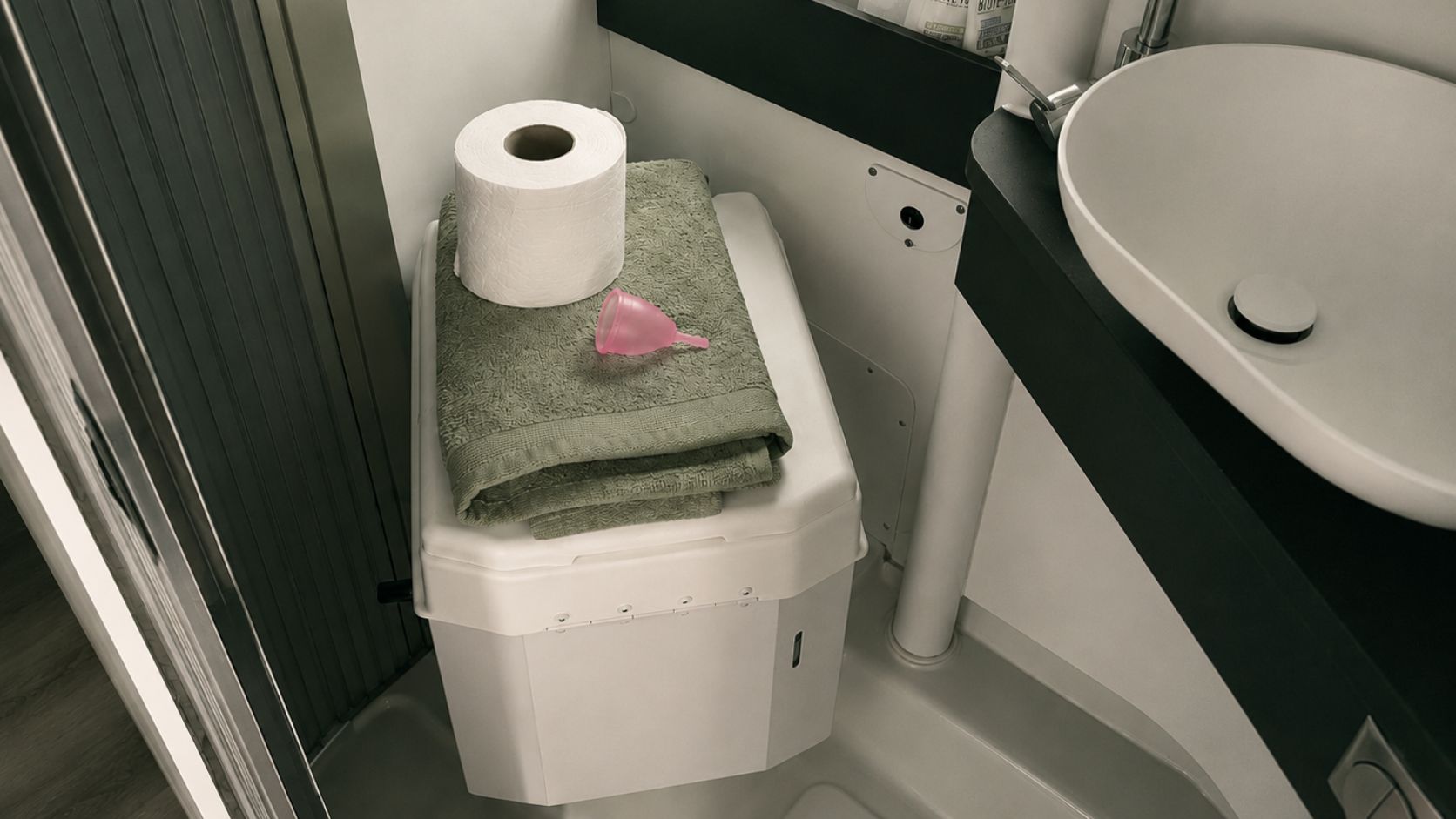
"On the road with a separation toilet, I have my safe space where I can take care of myself and my menstruation without stress," writes a vanlife camper in a guest article on a German dry separation toilet blog. The experience matches what the DACH community confirms across all forums: menstruation on a separation toilet is easier than most women thought before, if three points are clear. Menstrual cups are the preferred solution, tampons do not belong in the solid waste, and a small spray bottle with diluted acetic acid solves the cleaning issue.
What tampons, blood, and period cleaning really do with the separation toilet
Three mechanical questions repeatedly arise during menstruation. They have clear answers.
Why tampons cause problems in the solid waste system
Tampons behave fundamentally differently in the solid waste system than normal organic material: they absorb liquid and hold it in their fibers for a longer time. This directly contradicts the operating principle of a separation toilet with pre-composting.
In a classic composting toilet, the solid waste container is designed for drying: coconut fibers or other litter bind moisture on the surface, and a fan continuously removes residual moisture. The goal is a as dry and airy environment as possible, where odors do not develop in the first place.
A tampon acts like a moisture reservoir in the system. The bound liquid is not released quickly enough to the surroundings, creating a permanently damp area locally. These moist spots can disrupt the overall drying process and promote odor formation—even if the rest of the container functions correctly. There is also the risk that tampons wrap around the spindle. This can block the stirring mechanism and significantly impair composting.
It is important to distinguish from simple bag or pouch toilets: there, the contents are disposed of after each use, and moisture remains in the system only briefly. In such setups, a tampon is much less critical. In a dry separation toilet with a longer retention time in the solid waste container, however, the same effect lasts for days.
Practical recommendation: Small individual amounts can often still be buffered temporarily with additional litter. However, regularly disposing of tampons in the solid waste container measurably worsens drying performance and should be avoided.
Blood in the urine tank: only the color changes
Blood that gets into the urine tank when emptying the cup is mechanically unproblematic. The contents turn reddish, nothing else. "You can continue to empty the canister as usual every two to three days," says a German composting toilet guide. If light stains form in the canister after several cup emptyings, a diluted vinegar solution helps – a rinse, shake once, done.
Blood in the solid waste: why it remains odorless
On the solid waste side, coconut fibers absorb blood just as they absorb urine droplets. "The mass also absorbs blood odorlessly," writes an experienced motorhome user in a forum comment after several years of van life. In a dry composting toilet with a stirring mechanism, the blood is additionally actively bound and mixed with the fibers, which keeps odorlessness stable even during heavier periods.
Cup, tampons, and period underwear in practical comparison
During the period, the choice of hygiene product determines how much effort the composting toilet requires. Three cup methods, an honest tampon overview, a realistic look at period underwear, and a brief note on heavy periods or endometriosis.
Three methods to empty the menstrual cup
Those who use a menstrual cup have three ways to empty it on a composting toilet:
- Into the urine tank: Empty the cup over the separation insert; the urine takes the contents with it – the liquid turns reddish, nothing else. Then spray the separation insert with a diluted vinegar solution 1:7, wipe with toilet paper, done.
-
Into the solid waste container:
For bag or pouch toilets, the contents should always be covered with litter to bind moisture and odor.
With composting toilets with a stirring mechanism, the contents are simply cranked after emptying. Additional litter is usually not necessary here, as the mixing and aeration regulate the moisture. "In both cases, no unpleasant odor develops," writes a camper in a guest article for a German composting toilet manufacturer. - With compost use: "Did you know that the soil becomes very nutrient-rich because of this? Blood contains many trace elements, nitrogen, phosphate, and potassium, which are great for fertilizing plants," writes the same camper. For women who later compost the solid waste, method two is also an argument for fertilization.
Tampons and pads: what manufacturers really say
Manufacturer recommendations on tampons and pads in solid waste are inconsistent. Here is the honest overview:
| Manufacturer / source | Tampons in the solid waste? | reasoning | recommendation for vanlife |
|---|---|---|---|
| Trelino (DE) | no, never | fibers retain moisture, container climate spoils | separate trash bag in the bathroom |
| Kildwick (DE) | "okay, if you don't compost" | those who already use residual waste disposal can put them in | extra trash bag remains simpler |
| Nature's Head (US) | "no" – explicit guest instruction | Agitator blocks with hygiene products | not in the solid waste |
| BioTioo recommendation | extra trash bag in the bathroom, as a routine | safest answer for guests, avoids stress | double-pack, residual waste at the next rest stop |
(As of April 2026) Practically, this means: carry a small trash bag in the bathroom, pack used tampons or pads directly, and dispose of them in the residual waste at the next stop. A wild camping routine from the international community: double-pack dog waste bags, optionally add coffee grounds as an odor absorber.
Period underwear in the van: honest about the washing effort
Period underwear is still uncommon in the DACH market, but standard in the US. "Unfortunately, period underwear requires relatively high cleaning effort. The underwear must be washed very thoroughly after each use. Before it can be used again, it must also be completely dry," writes a German vanlife guide. This is a sticking point in a van: without running water, you need two to three changes, a waterproof storage bag between wearing and washing, and a planned washing break at a water source. More about travel logistics with periods is explained in the guide Separation toilet for women on the road.
Cup sizing for heavy periods or endometriosis
Anyone who needs to change the cup every four hours or more often in the first days probably doesn’t have the right size. "If you need to change the cup more than every 4 hours on your heaviest day – you may need a better fit," writes a woman with heavy bleeding in an English-language Reddit thread about composting toilets and periods. For heavier periods, a larger cup helps, a second reserve cup for intense days, or the combination of cup plus period underwear for extra security. This does not replace medical advice; recurring issues should be addressed by a gynecologist, not a camper guide.
How BioTioo specifically relieves the period
Three components of the BioTioo 2.0 RL make the difference during the period.
Stirring mechanism + coconut fibers: why blood in the solid waste remains odorless
Those who empty the menstrual cup directly into the solid waste container find it easier with the stirring mechanism version: the stainless steel spindle crushes and mixes the contents with the coconut fibers after each lid closing. Blood is actively bound instead of just absorbed – the climate inside the container remains stable, and the odor stays earthy.
SmellX and the 10-liter urine tank: no odor despite cup contents
Those who empty the cup into the urine tank benefit from the airtight SmellX odor seal, a patented floating ball instead of a rubber membrane, tight even when tilted in the camper. The 10-liter urine tank in DIN-96 wide-neck format is removed from the top inside and lasts two to three days for two people even with cup emptying. When rinsed with a diluted vinegar solution 1:7, the reddish stains reliably disappear.
Closure lid: for discreet transport (travel routine in its own guide)
Anyone who wants to discreetly carry the urine tank to a public toilet – especially during the period with reddish content – can add the BioTioo closure lid as an add-on: opaque protection in red, easy tank handling. How this looks in everyday travel, with safety aspects for solo travelers and travel hygiene kits, is explained in the guide Composting Toilet for Women on the Go.


