



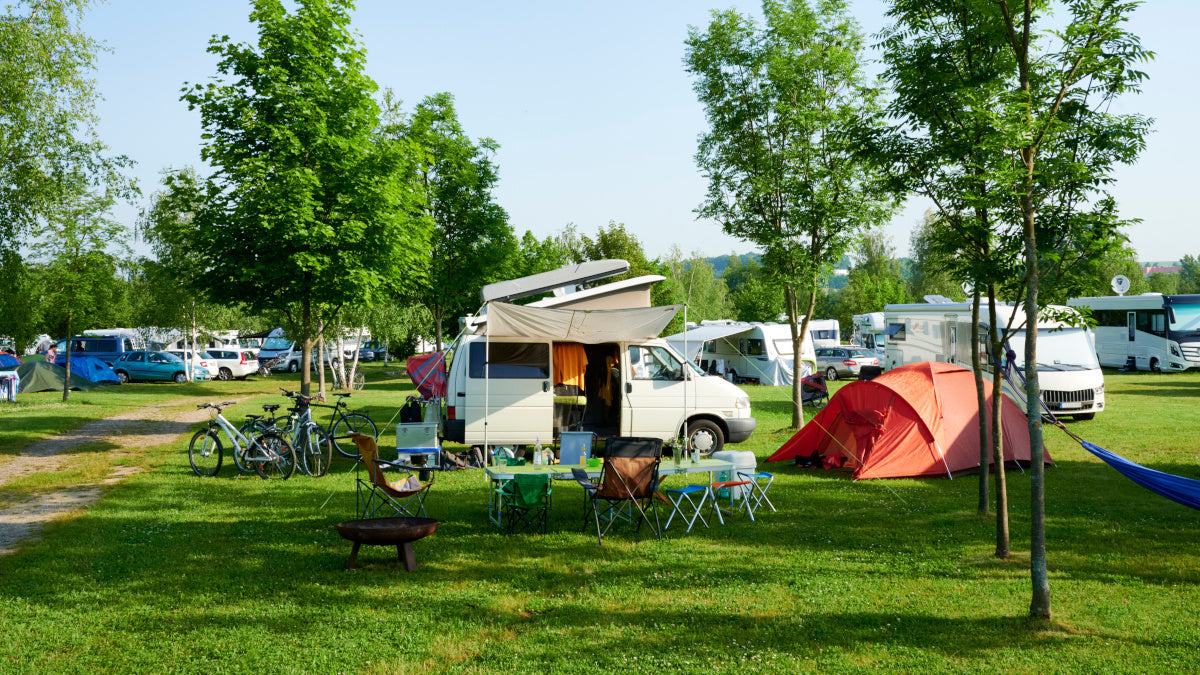
Over 3,150 campsites are spread across the whole country. But which of them are really the most beautiful campsites in Germany? Spoiler: It depends on what you are looking for. With 42.9 million camping overnight stays in 2024, the selection is huge, and not every site that shines on paper convinces on location.
Exactly for this reason, Sascha Gerner from BioTioo, who has been traveling with a camper for over 25 years himself, has compiled these sites from a genuine camper perspective.
How large are the pitches? How close are you to nature? And how well can you camp there self-sufficiently? Here are our 10 favorites, from the natural Baltic Sea insider tip to the Alpine resort with Watzmann view.
Whether you are traveling as a family with children, as a couple, or alone, a different adventure awaits you in every federal state.
What really makes a campsite in Germany special?
The most beautiful campsites in Germany are not defined solely by 5 stars or ratings. What matters is the combination of location, nature experience, and infrastructure that makes your camping holiday uncomplicated. These criteria count most from camper experience:
-
Close-to-nature location, directly by the lake, sea, or in the forest
-
Spacious pitches with sufficient privacy
-
Well-maintained sanitary facilities and modern infrastructure
-
Peace and relaxation instead of mass processing
-
Variety and leisure activities in the surroundings
-
Comfort and self-sufficiency friendliness, from electricity to water to supply and disposal
Close-to-nature location mean more to campers than just a nice view. It's about opening the door in the morning and being right in the experience, whether that's the Black Forest, the Baltic Sea, or the Bavarian Alps. The feeling of freedom and closeness to nature makes the camping holiday truly special.
Spacious pitches make the difference between "tight like a parking lot" and "real camping feeling." Plots from 100 square meters give you the space you need. For families with children, sites near playgrounds or swimming spots are ideal.
Comfort and self-sufficiency is a criterion that most camping guides completely ignore. Yet it largely determines how freely you can move around the site, from the length of emptying intervals to independence from sanitary buildings. Good power supply, clean disposal stations, and proximity to supply options are definitely part of it.
Which are the 10 most beautiful campsites in Germany?
From the Baltic Sea coast of Schleswig-Holstein to the Berchtesgaden Alps, Germany offers campsites for every taste. These 10 sites convinced us the most from a camper's perspective, each in its own way:
-
Camping Münstertal, Black Forest idyll with wellness
-
Südsee-Camp, Caribbean flair in the Lüneburg Heath
-
Naturcampingpark Isarhorn, Alpine Panorama near Mittenwald
-
Camp Langholz, Wild Camping Feeling on the Baltic Sea
-
Camping Wulfener Hals, Water Sports Paradise on Fehmarn
-
Camping Hopfensee, Allgäu panorama right by the lake
-
Uhlenköper-Camp, eco-natural camping in the Heath
-
Camping-Resort Allweglehen, Berchtesgaden Alps up close
-
Waldcamping Am Großsee, pure nature in the Brandenburg Lake District
-
Campingplatz Biehl, North Sea idyll in St. Peter-Ording
Camping Münstertal, Black Forest idyll between vineyards and forests
Camping Münstertal is located in the heart of the Black Forest in Baden-Württemberg at 360 meters altitude and is one of the best campsites in the whole country with its ADAC Superplatz award and 5 stars. The approximately 334 pitches are between 80 and 130 square meters in size and nestled among vineyards and Black Forest fir trees.
What makes this campsite special: Here you get camping and wellness in one. A heated outdoor and indoor pool, sauna, and even physiotherapy are available directly on the site. Children find variety on the playground, while couples enjoy the wellness offers. At the same time, hiking trails and cycling routes start practically at the pitch.
Camper tip: The pitches in the rear area offer more peace and a better view of the forest. With a rating of 9.5 out of 10 points from over 146 guest reviews, Camping Münstertal is one of the highlights in the state of Baden-Württemberg. Prices are around 35 to 38 euros per night. Dogs are welcome, including a dog shower and agility course. Nearby, a trip to the city of Freiburg or to the castles in the Black Forest is worthwhile.
Südsee-Camp, Caribbean flair in the Lüneburg Heath
The Südsee-Camp near Wietzendorf in Lower Saxony covers 90 hectares and offers a natural experience worthy of its name with its own natural lake including a sandy beach. The 3-hectare lake is the centerpiece of the ADAC Superplatz and ideal for swimming for the whole family.
With 726 tourist pitches, the Südsee-Camp is one of the largest camping and holiday parks in the Lüneburg Heath. The pitches vary between 80 and 220 square meters, providing enough space even for larger motorhomes. In addition to the indoor pool, there is a riding facility, an 18-hole golf course, and the indoor playground "Pirate Nest" for children. Families will find so much variety here that this campsite alone can fill an entire camping holiday.
Camper tip: The Südsee-Camp is open year-round and is also suitable for camping in the colder season. Prices range between 32 and 58 euros per night depending on the season. With a rating of 8.9 from over 500 reviews, the site consistently delivers. It is also ECOCAMPING certified. For children, the leisure park with the pirate nest is one of the biggest highlights.
Naturcampingpark Isarhorn, Alpine Panorama near Mittenwald
Naturcampingpark Isarhorn is located at 900 meters altitude right on a bend of the Isar near Mittenwald in Bavaria, with views of the Karwendel mountains up to 2,749 meters. A campsite in Germany where the location alone leaves you speechless.
The 180 tourist pitches are spread over a natural area between the Isar and the mountains. Especially practical: the campsite has its own train stop directly on the grounds, ideal for day trips to Innsbruck or Garmisch-Partenkirchen without a car. In summer, you can swim directly in the Isar; in winter, nearby ski resorts beckon.
Camper Tip: The Naturcampingpark Isarhorn is ECOCAMPING certified and focuses on nature experience instead of wellness luxury. Hiking in the Alps, cycling along the Isar, or simply relaxing with mountain views—everyone finds their camping happiness here. A ski drying room is available in case you come in winter. The bread roll service delivers fresh goods directly to your pitch in the morning. For families with children, the Isar gravel banks offer an adventure playground right in nature.
Camp Langholz, Wild Camping Feeling on the Baltic Sea
Camp Langholz near Waabs on the Schleswig-Holstein Baltic Sea coast is the opposite of an over-organized holiday park. The motto "We camp differently" is the program: no asphalt paths, no garden gnomes, but 300 meters of sandy gravel beach right at the site.
With only 71 tourist pitches, Camp Langholz is one of the smaller campsites on the German Baltic Sea coast. That’s exactly what makes it appealing. The site is located on the grounds of a former fishing village and has existed for over 50 years. When you arrive here, you immediately feel: nature and connection to nature come first. For couples seeking peace and relaxation, this campsite is a true paradise.
Camper Tip: Camp Langholz is open from March to October and is fairly priced between 23 and 34 euros per night. The sanitary facilities are deliberately simple, fitting the natural concept. If you want to combine wild camping atmosphere with the security of a regular campsite, you'll find the perfect compromise here. Nearby, there are opportunities for cycling along the coast, and the town of Eckernförde is quickly accessible.
Camping Wulfener Hals, Water Sports Paradise on Fehmarn
According to PiNCAMP, Camping Wulfener Hals on Fehmarn is the most requested campsite in all of Europe. The site extends over 34 hectares on a peninsula between the Baltic Sea and Burger Binnensee, with water access from almost all sides.
The 399 tourist pitches offer between 95 and 150 square meters of space. The infrastructure reads like a small holiday park: 6 restaurants, surf school, diving station, 18-hole golf course, and indoor pool. For children, there are animation programs and playgrounds; for couples, the secluded beach pitches offer peace and relaxation. ECOCAMPING certified and open year-round.
Camper tip: The Wulfener Hals campsite on Fehmarn is ideal for families and water sports enthusiasts. Surfing, sailing, kiting, and diving are possible right on the doorstep. Prices range between 29.50 and 40.46 euros per night. With 689 reviews and a rating of 8.3, it is one of the highlights among campsites in Schleswig-Holstein. In high season, you should definitely reserve in time. The leisure activities offer so much variety that you won’t want to leave the site.
Camping Hopfensee, Allgäu panorama right by the lake
Camping Hopfensee near Füssen in the Allgäu belongs to the top class of campsites in Germany with its ADAC Superplatz award and 5 stars. Located directly on Hopfensee, you open the camper door in the morning and look out at the Allgäu Alps. Comfort and nature go hand in hand here.
377 tourist pitches, a heated outdoor and indoor pool, wellness with saunas, and a 1,000 square meter children's playhouse provide variety for the whole family. Children love the playhouse, couples enjoy the wellness area. Important to know: Camping Hopfensee only accepts motorhomes, caravans, and rental accommodations. There are no tent pitches. Reservation is mandatory.
Camper tip: The rating of 9.4 from 181 reviews speaks for itself. Camping Hopfensee is a 5-star campsite in Bavaria that combines luxury and nature experience. From here, you can reach Neuschwanstein Castle, Forggensee, and the Allgäu hiking trails within minutes. Swimming in Hopfensee, hiking in the mountains, or cycling along the lakes, the state of Bavaria offers highlights nearby for every taste.
Uhlenköper Camp, eco-nature camping in the Lüneburg Heath
The Uhlenköper Camp near Uelzen in Lower Saxony shows that nature camping and comfort do not have to be a contradiction. ADAC 4 stars, ECOCAMPING certification, and a rating of 9.2 from 594 reviews, this campsite in the Lüneburg Heath has a loyal fan base.
On 4 hectares, 85 tourist pitches from 100 to 120 square meters are spread out. The highlight: a plant-filtered natural outdoor pool, completely chlorine-free. There are also organized canoe trips, cycling through the heath, and a petting zoo for children. The car-free tent meadow ensures peace and relaxation, which you can truly enjoy in the heath landscape. Families especially appreciate the nature education program.
Camper tip: Those looking for high-level eco-camping in Germany will find the complete package at Uhlenköper-Camp. With 21 to 39 euros per night, the site is reasonably priced. In 2025, the hotel "11 Eulen" with 9 rooms was newly opened if you want to try a night without camping. Nearby, the town of Uelzen attracts visitors with the Hundertwasser train station as a highlight for a day trip.
Camping-Resort Allweglehen, Berchtesgaden Alps up close
Camping-Resort Allweglehen near Berchtesgaden is located at 570 meters altitude on the edge of Berchtesgaden National Park, with a direct view of Watzmann and Königssee. A campsite in the German Alps that is truly unique.
218 tourist pitches between 100 and 200 square meters also offer plenty of space for large motorhomes. The wellness facilities are unusual for a campsite: Finnish sauna, infrared cabin, and even an alpine hay sauna. ADAC 4 stars and ECOCAMPING certified. Children enjoy the playground and proximity to hiking trails, couples appreciate the wellness area after an adventure in the mountains.
Camper tip: Camping-Resort Allweglehen is open year-round and therefore perfect for winter camping in the Alps. Six ski resorts are within 50 kilometers. With 55 to 58 euros per night, it is one of the more expensive campsites, but the location at Königssee in the state of Bavaria justifies the price. Hiking to Königssee, swimming in Hintersee, or simply enjoying the mountain view—you'll find relaxation and adventure here at the same time. Dog owners will appreciate the dog shower and agility course.
Waldcamping Am Großsee, pure nature in the Brandenburg Lake District
Waldcamping Am Großsee near Tauer in Brandenburg is the insider tip for those looking for camping away from the big tourist crowds. Located directly on the Großsee, in the middle of the "Unteres Schlaubetal" landscape protection area, time moves slower here. The lake landscape in this region is reminiscent of Mecklenburg-Western Pomerania but is much less crowded.
With only 17 tourist pitches, Waldcamping Am Großsee is one of the smallest campsites on our list. That is exactly the charm: peace, nature, water. A beach by the lake, forest all around, and the Spreewald nearby for day trips. Swimming in the Großsee is one of the highlights, and the water quality is excellent.
Camper Tip: This campsite in Brandenburg is open from April to October and costs between 29.70 and 31.70 euros per night. For campers who consciously seek small and nature-close campsites in Germany, this is a real gem. The infrastructure is simple, but for a few days of forest idyll, you don’t need more. The silence by the lake alone makes this site special. Cycling, paddling, and hiking nearby offer enough variety for couples and families with children.
Campingplatz Biehl, North Sea idyll in St. Peter-Ording
Campingplatz Biehl is located directly on the dike in St. Peter-Ording on the Schleswig-Holstein North Sea coast. Wadden Sea right in front of you, wide sky above your head. North Sea camping as it should be. Dunes, beach, and the vastness of the North Sea make this campsite a special place for nature connection and relaxation.
About 120 pitches are spread over 3 hectares, of which 70 are for motorhomes and 50 for tents. The on-site fish-and-chips bistro with homemade cake is a nice special feature. Wi-Fi is available free of charge throughout the site. Electricity is available at every pitch.
Camper Tip: With 44 to 51 euros per night, Campingplatz Biehl is among the more expensive sites; the North Sea coast has its price. But here you stand with your camper at the Wadden Sea and can walk kilometers into the mudflats at low tide. For children, the mudflats are a huge adventure playground. For North Sea fans among campers, this is one of the most beautiful campsites in Schleswig-Holstein. Near the town of St. Peter-Ording, you will find restaurants, spa facilities, and water sports. A trip to the islands is also worthwhile.
What Should You Look for When Choosing a Campsite?
When choosing the right campsite in Germany, more matters than just the star rating. From years of camper experience, these criteria are crucial for a successful camping holiday:
-
Location and Arrival, Travel Time and Accessibility in the Respective Federal State
-
Pitch Size and Plotting, Privacy Instead of Sardine Can
-
Sanitary Facilities, Cleanliness Matters More Than Design
-
Leisure Activities in the Surroundings, whether Hiking, Water Sports, or Culture
-
Nature Experience, whether Lake, Forest, Mountains, or Sea right at the Site
-
Comfort and Self-Sufficiency Equipment, from Electricity and Waste Disposal to Independence
-
Location and ArrivalThe most beautiful campsites in Germany are not always located near the highway. Allow enough time for the journey and check for access restrictions for larger motorhomes. Depending on the federal state, the arrival can vary greatly. Popular camping regions include, besides the Black Forest and the Alps, the Saxon Switzerland, the Moselle in Rhineland-Palatinate, the North Sea, and the lake landscapes in Mecklenburg-Western Pomerania and Brandenburg.
-
Pitch size: At least 100 square meters should be available if you are traveling with a motorhome or van. Unpartitioned meadows sound romantic but can get crowded in peak season. This means for you: better a smaller site with generous pitches than a mega holiday park with a sardine-can feeling. Families with children usually need even more space.
-
Sanitary facilities: A clean sanitary facility makes the difference, especially if you stay several days at the same campsite. Warm water, individual cabins, and family bathrooms are not a given. In any case, you should read the reviews before booking.
-
Nature experience and highlights: Campsites directly by the water or in the forest offer a different experience than those on the city outskirts. The location determines how close you really are to nature. Whether hiking in the mountains, swimming in the lake, cycling through the holiday region, or visiting castles nearby, the country offers the right variety for every couple and family.
-
Comfort and self-sufficiency at the campsite: Anyone who wants to camp independently for weeks needs the right equipment, from solar panels to sufficient water tanks to a dry separation toilet. Electricity at the pitch is standard, but true freedom only begins with the right onboard equipment. A self-sufficient toilet solution like our BioTioo dry separation toilet makes you completely independent from disposal stations and sanitary facilities, chemical-free, odor-free, and without water consumption. No more disposal stress.
Self-sufficient camping with the BioTioo 2.0
You enjoy the most beautiful campsites in Germany when you don’t have to worry about disposal times and full sanitary facilities. The BioTioo 2.0 makes you completely independent: chemical-free, odor-free, and without water consumption.
Urine and solids are collected separately. The 10-liter urine tank is sufficient for 2 to 3 days for two people, and the solid waste container with a stirring mechanism allows up to 25 uses before the next emptying. The patented SmellX odor seal system keeps everything odor-free, even in the height of summer.
Our BioTioo dry separation toilet is completely manufactured in Germany - with a stainless steel housing, ergonomically widened seat, and 12V fan with flexible connection on three sides. Thanks to the modular design, the BioTioo adapts to any camper, whether permanently installed or mobile.

