



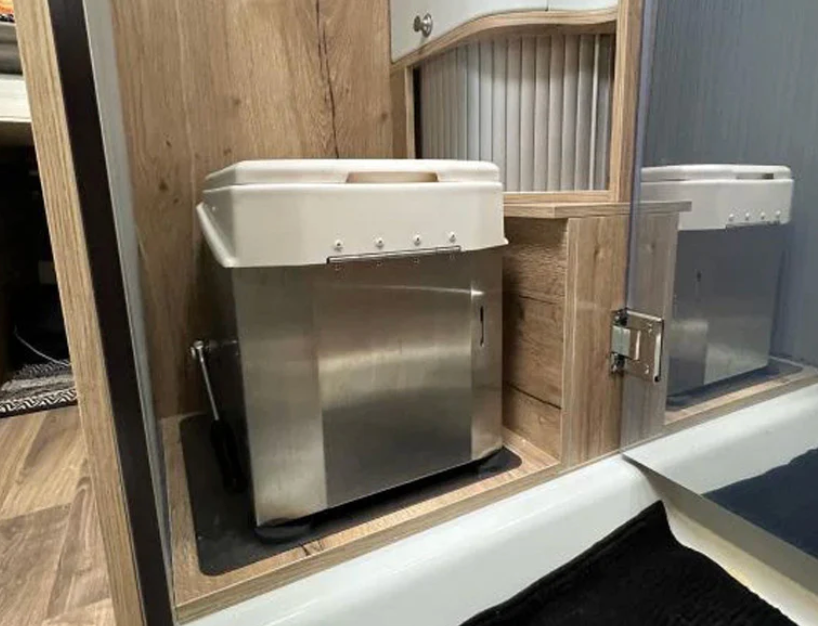
A BioTioo remains odor-tight even when left unused for weeks: the urine path is mechanically sealed, the solid waste chamber is already dried out when paused, and none of this necessarily requires electricity. We designed the construction in Überlingen specifically for this scenario: the idle period is not a special case of the technology but a planned operating state. The only crucial factor is the condition in which you leave the toilet.
Idle time is a design case
Inside a stationary composting toilet (with a stirring mechanism), very little happens by design: urine and solids never come into contact, and only this contact triggers the odor-causing decomposition processes. The entire odor chain is explained in Why a dry toilet doesn’t stink. Without this trigger, the idle time has no effect on odor, regardless of how long the toilet stands.
Three features support the idle time:
- The urine path remains sealed. The SmellX mechanically seals the liquid and air openings of the tank, airtight and leak-proof even on an incline; a camper parked on a slope is accounted for. The design is shown in The SmellX odor seal.
- The solid waste chamber is already dried out when paused. It’s not the lid that keeps the contents stable, but the stirring mechanism: it fully mixes each addition into the coconut fibers during use, distributing moisture and drying it out instead of fermenting in one spot. Therefore, what remains in the chamber at the end of the last use hardly changes during idle time.
- No rubber parts age in the seal. Membranes wear out or stick over time. Instead, a ball without a replacement interval sits in the urine path of the BioTioo; the reasons are explained in our design decision for the urine path.
Electricity does not play a role in this chain, and that is the crucial difference during idle time. Designs whose odor control depends on a running fan or a water-based flush lose this protection as soon as the onboard battery runs out over weeks; stagnant water in such a system also becomes a hygiene risk. A purely mechanical seal has no such failure mode: it needs neither electricity nor water to remain tight. Why we fundamentally designed odor control as a passive state rather than an active function is explained in Passively tight.
We clearly name one exception: the filled urine tank. It remains odor-tight sealed, but standing urine deposits limescale faster over time, which is a maintenance issue, not an odor issue. Therefore, the tank should be emptied before any longer pause; the background is explained in Avoiding limescale.
Our recommendation for the idle period

The pause itself does not create a new problem; it only preserves what you leave it. Two routines cover all cases.
Up to about two weeks, for example between two trips:
- Empty the urine tank. This is possible with any normal toilet, and disposal is very easy.
- Turn the stirring mechanism once (compost variant). A few crank or motor turns fully distribute the last addition into the coconut fibers so it dries instead of fermenting. This step is omitted for the bag variant.
- Close the lid. The short pause requires no more.
Several weeks up to the whole season:
- Empty and clean both containers. The solid waste container can be removed with one lift; the housing remains installed. All steps are shown in the dry toilet cleaning guide.
- Disassemble and rinse the SmellX. The seal can be disassembled in a few steps; urine residues do not survive the pause.
- Store dry. Insert containers dry, close the lid.
Two honest additions are necessary. In the bag variant, the bag is removed before each pause; a full bag is trash, and trash never stays in a vehicle for weeks. And before winter: a dry toilet does not store water, which is one less frost risk. However, collected urine freezes in every system. So here too, empty the tank first, then store.
After the pause: one step only if emptied beforehand
Restarting depends on emptying, not on the pause itself. If the solid waste container and urine tank were not emptied during the idle time, nothing changes: use continues as before, no transition step is needed.
Only after emptying, for example at the end of the season, is refilling necessary. Insert a clean solid waste container, connect the urine tank, then continue depending on the operating type: for the compost variant, fresh filling from the FiberBox goes in; the compressed coconut brick swells only with hot water and takes a few minutes. For the bag variant, a new bag and normal litter suffice, with no swelling time. In both cases, no run-in time is needed afterward: no chemicals that can spoil, no flush water that can rot. What fundamentally makes a dry toilet different is explained in How a dry toilet works.
Availability
All variants are built for standing idle: the BioTioo 2.0 with stainless steel housing and 10-liter urine tank as well as the BioTioo 2.0 RL-Motion. Its timer-controlled stirring mechanism mixes the contents after each lid closure before the pause begins. The SmellX seal is included as standard and also available separately as a replacement and retrofit part. This includes a 3-year warranty on bowl and lid and a 60-day return policy. You can find the model overview in our dry separation toilets.

