


The BioTioo operates completely without electricity: the separation works through the bowl shape, the odor trap through a floating ball, and the stirring mechanism through a hand crank. This is not an emergency feature but the core of the design. Electricity automates work in this system; it does not support a single basic function.
Mechanics support, electricity automates
We have divided the functions into two layers. Without electricity, the BioTioo loses convenience, not function.
The mechanical layer is always available. The bowl separates urine and solids solely through its geometry, with two integrated bases and a high separating wall (the basics are explained in How a Separation Toilet Works). The urine flows into the 10-liter tank, and the solids remain in their closed, drying chamber. Emptying also requires no technology: you simply lift the solid waste container out with one handle and empty the urine tank at any toilet. There is no flushing system that could stop without a pump, as the system operates water-free and chemical-free. In winter, this reduces frost risk because no flushing water can freeze; however, collected urine can freeze in any system during severe frost.
The electrical layer is optional: a 12-V fan with 1 W power that supports drying, and the stirring motor that automates cranking. Both are modules above the mechanical base, not load-bearing parts.
The odor trap relies only on physics

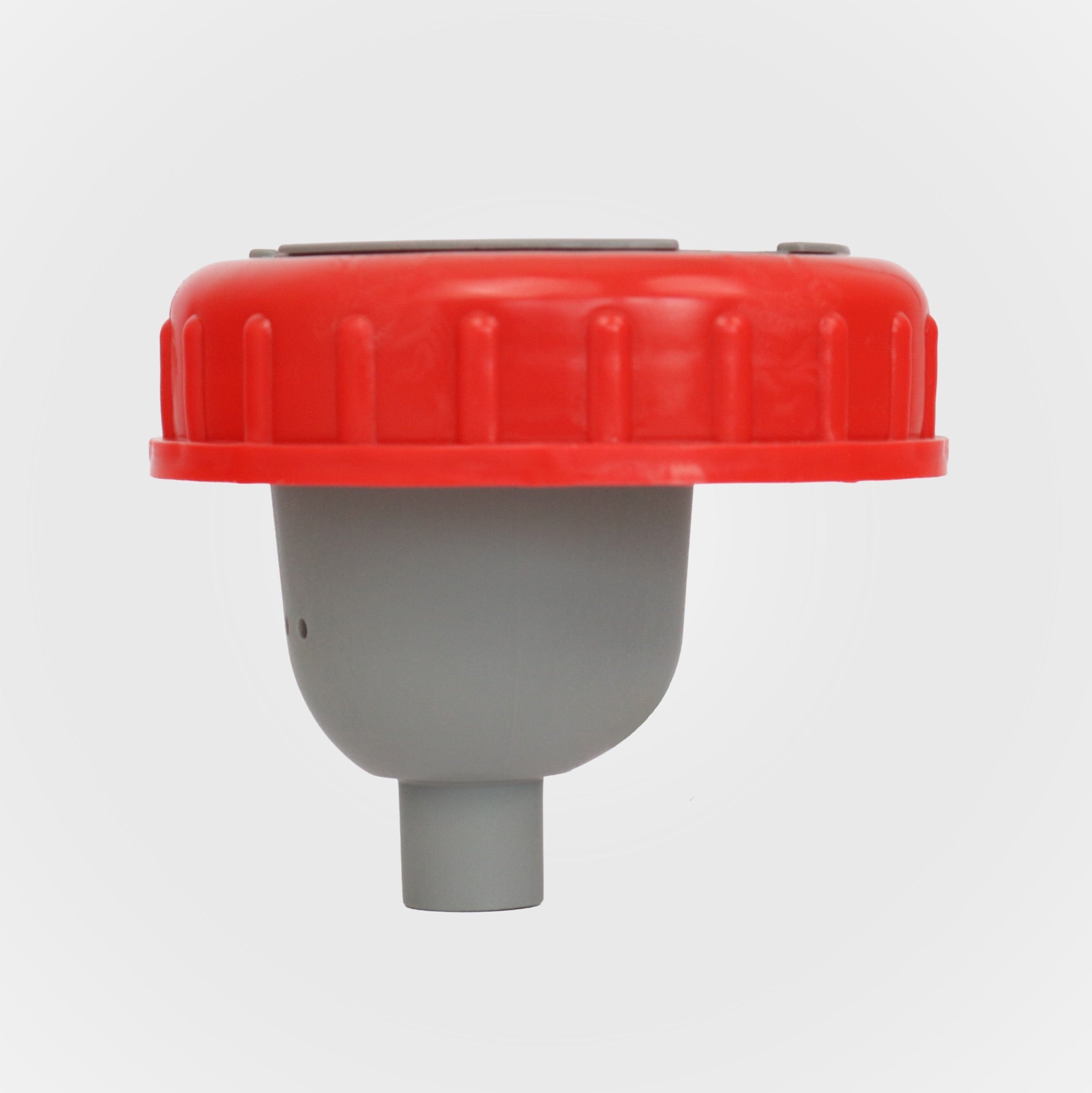
The SmellX with its floating ball is located at the urine path. When urine flows, buoyancy lifts the ball and opens the way to the tank. When the flow ends, the ball sinks back into its seat and seals the liquid and air openings of the tank independently: airtight and leak-proof, even on slopes or vibrations on the road. There is no rubber membrane that could fatigue in this design, nor any component that requires power. The seal depends on buoyancy and gravity, not on battery charge level. The mechanics are detailed in the factory note on the odor trap with floating ball; why the odor control overall works without continuous ventilation is explained in Passive Seal.
Empty battery changes routine, not function
The practical case: you are camping off-grid for the third day, the sun is missing, and the onboard battery reports low voltage. The toilet visit proceeds exactly as usual. The bowl separates, the ball seals, and with the compost variant, you turn the crank a few times afterward so the coconut fibers cover the fresh addition (what stirring achieves is explained in the factory note on the stirring mechanism).
Two limitations must be honestly mentioned. In the motor model, nothing stirs automatically without power; however, the hand crank is always included, drives the same stirring shaft, and requires neither tools nor conversion (TiooMotion: the motor with hand crank). The optional fan also stops, so its drying support is missing as long as there is no power. However, the odor concept never depended on it: separation, litter, and stirring alone maintain it. Its undervoltage protection also switches off the fan before it drains the onboard battery further.
To put the endurance times into perspective: the urine tank (usable 9.9 liters) lasts about 6.5 days for one person, about 3 days for two; the solid waste container lasts about 14 days for two. So, off-grid, you are usually limited by the urine tank, not the electronics.
Which designs fail without electricity
This comparison is about design knowledge, not brand. Electric flushing and macerator toilets pump waste: without onboard power, flushing fails, and the toilet is blocked or only partially usable. Dry toilets whose odor control relies on a continuously running fan make odor barriers a power issue. The fan draws power from the battery around the clock. If it stops, the only barrier fails. Purely electric stirring mechanisms without mechanical alternatives leave the material unmixed once power ends. It remains moist, and moisture triggers odors.
It becomes more critical when several of these functions in the same design share the same power circuit. If a single sensor controls stirring, fan, and a water-based cleaning system together, a failure in the pump, sensor, or motor disables not just one function but several simultaneously: odor control, hygiene, and mixing fail at the same time. A water-based system also carries an additional risk that a purely mechanical separation does not know: it can freeze.
In our system, electricity also stops then, applying to every motor and fan. The difference lies in the foundation: with BioTioo, fan and motor are add-on modules above a mechanical base. Without power, it loses automation; a design whose basic function is electric loses its function.
Availability
Variants B and R of the BioTioo 2.0 operate completely without electricity; fan and motor can be ordered from the factory or retrofitted later. The hand crank is always included even with the motor model RL-Motion. The system is developed and manufactured by us in Überlingen on Lake Constance. We offer a 3-year warranty on the bowl and lid, plus a 60-day return policy. All models are shown in the overview of dry separation toilets.