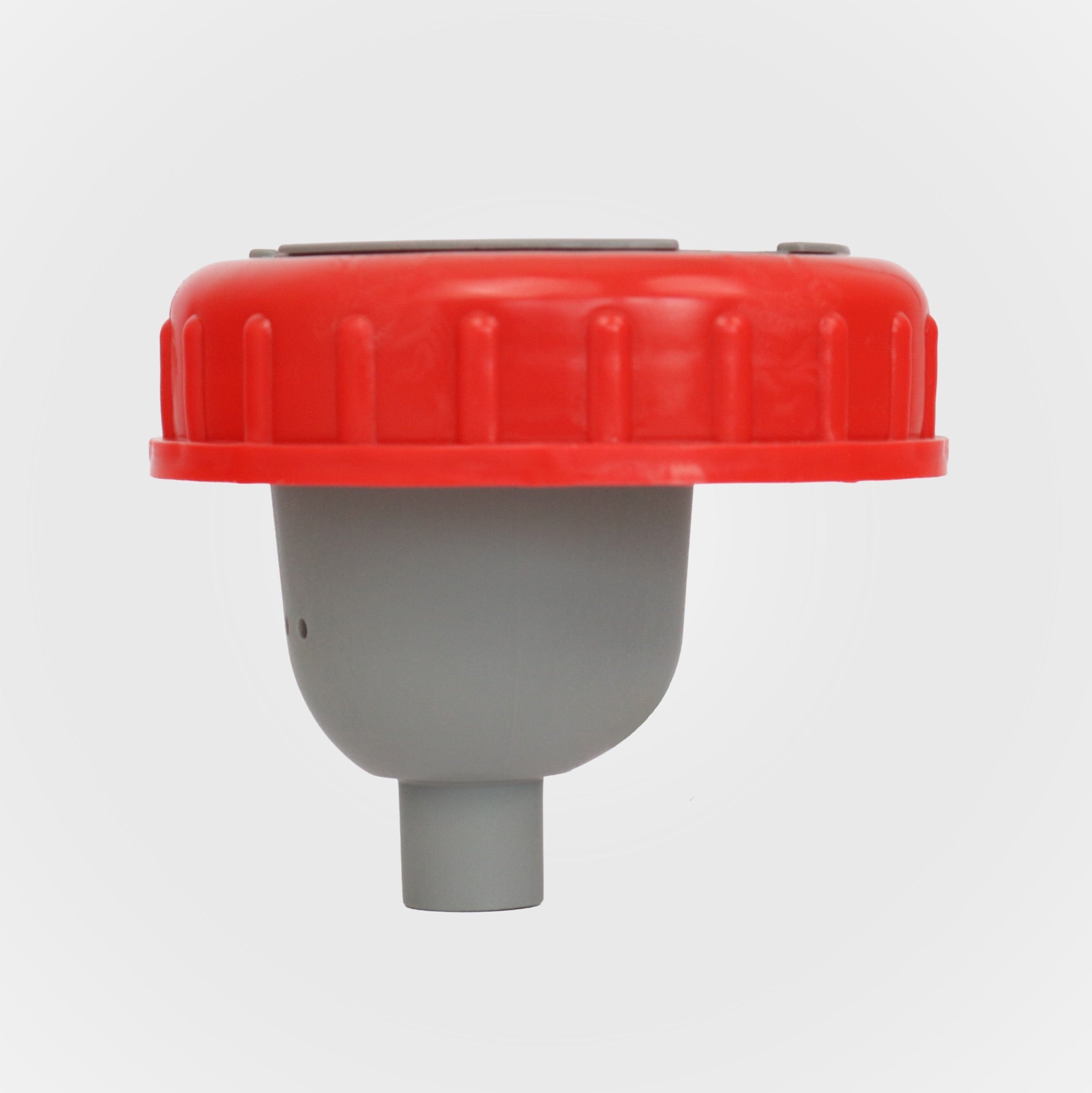



The BioTioo seals its urine path with a floating ball, not with a rubber part. We have chosen this over two established designs: the membrane and the beak check valve. All three systems solve the same task. They only open the path to the urine tank when urine flows and otherwise keep the tank air sealed. The difference lies in where the closing force comes from and what that means for years of use in the vehicle.
Three designs, one task
All three closure designs are located in the urine path between the separation insert and the tank. All three operate automatically and without power (the separation principle behind explains how the separating toilet works):
- Membrane: an elastic rubber part. The flowing urine pushes it open, and the material’s tension pulls it closed again.
- Beak check valve: a soft funnel made of rubber or silicone. The flow pushes the overlapping lips apart, and their inherent tension closes them again afterward.
- Floating ball: a ball in a ball seat. The buoyancy of the urine lifts it, its own weight lowers it back, sealing both the liquid and air openings.
The membrane and beak valve only regulate the liquid path. To allow air to flow in and out of the tank, these designs require an additional permanently open vent opening elsewhere in the lid or housing. The floating ball performs both tasks in one component: the liquid and air openings are next to each other in the ball seat, and in the closed state, the ball covers both simultaneously. This eliminates the need for an additional permanently open vent opening entirely.
Membranes and beak valves derive their closing force from the elasticity of a rubber part, while the floating ball uses gravity and buoyancy. This single sentence was our decision basis.
| Criterion | Membrane | Beak valve | Floating ball |
|---|---|---|---|
| Closing force | Material tension | Material tension | Gravity and buoyancy |
| Ventilation | Additional permanently open opening needed | Additional permanently open opening needed | Covered by the ball, no additional opening |
| Aging | Fatigues and sticks over time | Lips fatigue, declared replaceable part | No fatiguing rubber parts, limescale remains an issue |
| Disassemblability | Depending on model, fixed installation | Removable insert | Into individual parts, without tools |
(Design and disassemblability of membrane and beak valve depend on the model; we describe the designs, not specific products.)
Our three reasons for choosing it

Behind the choice of the ball are three design principles. They come from the development work of Sascha Gerner & Achim Cürten here in Überlingen:
- No replaceable parts. Because rubber fatigues or sticks, suppliers offer membranes and beak valves as replaceable parts. This applies regardless of the exact elastomer: Natural rubber like silicone is permanently under tension and loses this tension over time. We wanted a component without a replacement interval and without spare parts on board.
- Fully disassemblable. Urine scale forms on every urine path. A closure must therefore be disassemblable into individual parts so that every sealing surface remains accessible. A fixed rubber part can only be maintained from the outside; once the material fatigues, no cleaning helps anymore.
- Passive without exception. The closing force must not depend on electricity or material tension. Gravity and buoyancy are always available unchanged every day and seal even when tilted or vibrating. Why we base the entire odor concept on this powerless state is explained in Passive sealing.
The result of these principles is the SmellX, our patented floating ball closure. The construction, individual parts, and cleaning routine are shown in the component article The SmellX odor closure.
The honest calculation: descaling instead of replacing
The ball is not a maintenance-free component. Urine scale affects every design, including ours: deposits on the ball and ball seat eventually interfere with sealing. Our answer is a cleaning routine instead of part replacement: disassemble, rinse, occasionally descale with citric acid. This shifts the effort from repurchasing to cleaning; no design can eliminate it. How to keep deposits small is explained in Avoiding urine scale.
It’s also fair to say: a replaceable part system is predictable. Anyone who regularly installs a fresh rubber part also has a tight seal, just with recurring part needs. We consider the disassemblable ball the better calculation over the years; that’s why it is built into every BioTioo. How the closure, combined with separation and a dry chamber, becomes an odor-free overall system is shown in Why a separating toilet doesn’t stink.
How to disassemble, clean, and reinstall the SmellX is shown step-by-step by Sascha in this video: https://www.youtube.com/watch?v=kvy488ngmY8
The SmellX is included as standard with every BioTioo 2.0 and is available as a separate module, both for replacement and retrofitting on wide-neck canisters according to DIN 96. We offer a 3-year warranty on bowl and lid, plus a 60-day return policy. You can find the model overview with our dry separating toilets.