



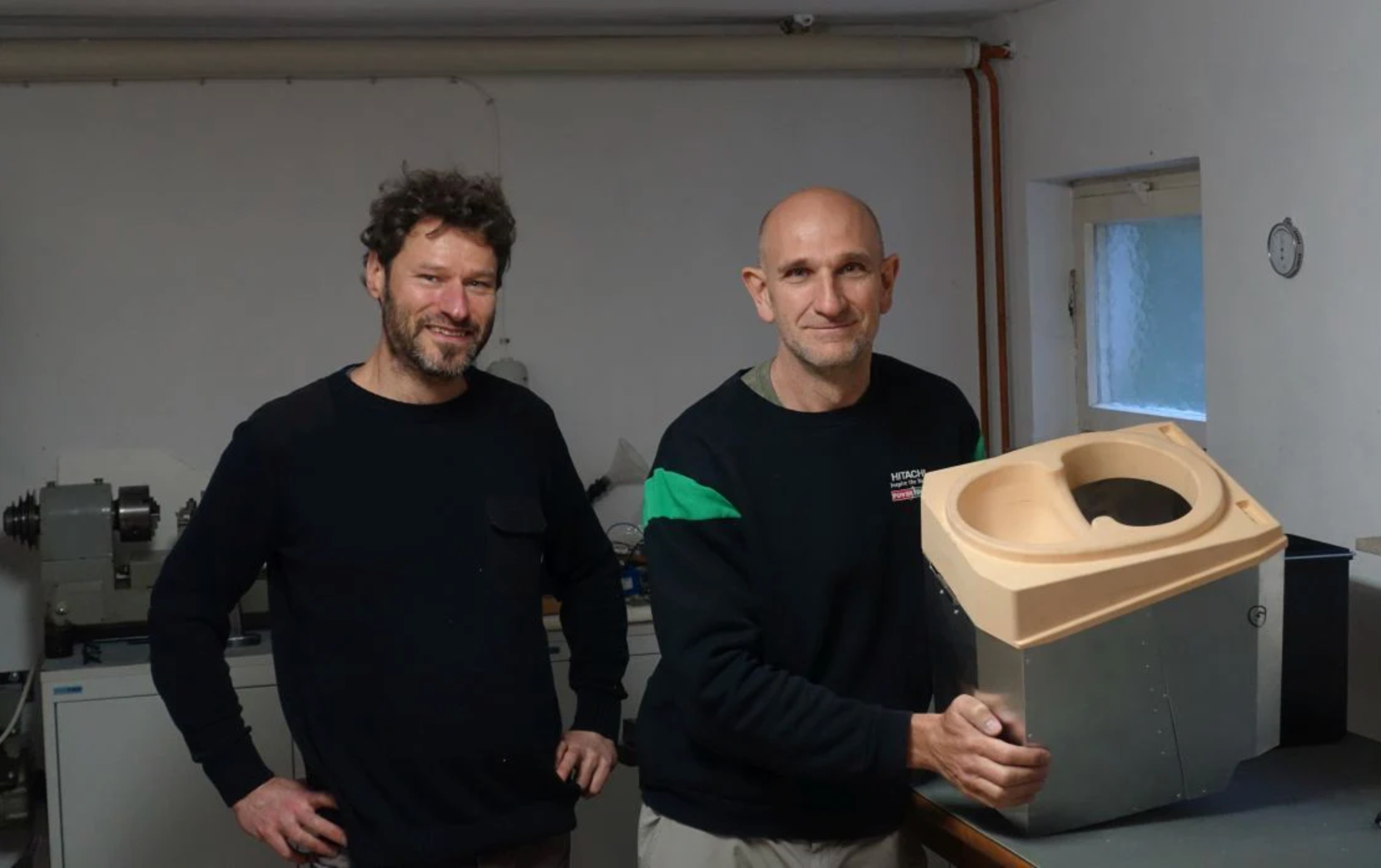
The BioTioo 2.0 consists of two materials: a housing made of brushed, riveted stainless steel V2A and a bowl with lid made of cold-impact-resistant polypropylene PP-C. This division is a design decision, not a compromise. In a toilet, the material determines hygiene, frost resistance, weight, and durability. That’s why each component in our product gets the material its function requires.
Pore-free hygienic surfaces made of stainless steel
A hygienic surface must be fully cleanable, not just wipeable. Stainless steel naturally meets this requirement: its smooth, brushed surface offers urine, lime, and germs hardly any crevices to settle in, unlike textured or porous materials. This allows the housing to withstand genuine wet cleaning: rinsing, soaking, wiping. The complete cleaning routine for housing, bowl, and urine channel is shown in Clean a dry toilet.
Commercial kitchens and sanitary rooms have been using stainless steel for exactly these reasons for decades. We adopted this standard instead of inventing a new one. The bare housing comes without coating: a scratch does not expose any foreign carrier material, underneath is stainless steel again. Care for the urine channel and tank is covered separately in Avoiding urine scale.
Two other materials are common on the market for toilet housings: powder-coated aluminum and wood. Powder-coated aluminum initially lacks the property our bare housing has: a scratch exposes the coating and the softer metal underneath, and dirt settles in the resulting micro-roughness. More importantly, aluminum reacts sensitively to ammonia and chlorides, both components of urine, and tends to develop pitting corrosion exactly at such exposed spots. If urine runs there for a long time, corrosion attacks the metal itself, not just the coating. Austenitic stainless steel like our V2A is designed to resist exactly this chemistry and is significantly more durable. Aluminum also conducts about ten times more heat than stainless steel (typical values: stainless steel about 15 W/(m·K), aluminum about 150 to 235 W/(m·K)) and therefore feels colder in winter.
Wood surfaces bring a different risk. Wood is porous and absorbs liquid into its fibers. If urine penetrates through a scratch or worn spot in the coating, odor substances and bacteria remain inside the material, unreachable by external cleaning. Over time, the wood swells and rots at these spots, even under a renewed varnish layer. That’s why wood surfaces often only tolerate damp wiping, no rinsing, according to the respective manufacturer’s instructions—a severe limitation especially in wet rooms. For this reason, we chose bare, uncoated stainless steel.
PP-C on bowl and lid, intentionally
We don’t bash plastics. We use plastic ourselves; what matters is which one. “Plastic” is a generic term, not a material specification; only the datasheet makes it meaningful. Our polypropylene PP-C is UV-resistant and cold-impact resistant: it remains impact-resistant at subzero temperatures where unspecified polymers become brittle.
For bowl and lid, PP-C is even superior to steel. The separation of urine and solids works purely through the bowl’s geometry: two integrated feet as seat support, a high separating wall against backflow. This shape can be produced much more precisely by injection molding than from sheet metal. Its lower thermal conductivity also makes PP-C feel warmer when sitting than metal. That’s why we decided against a single material: a toilet made entirely of steel wouldn’t be a better toilet, just a heavier one. Direct contact with solids is therefore on PP-C, not stainless steel: the hygiene advantage of bare steel applies to the supporting housing, not the bowl itself. (How the separation works in the overall system is explained in the basic article How a dry toilet works.)
200 kg load at 6.5 kg weight
The housing supports up to 200 kg, the complete toilet weighs 6.5 kg. Both at the same time is only possible with thin-walled stainless steel. The sheet gains its stiffness from geometry: bends and rivets hold the shape, not material thickness. The mounting points are also in the metal: screw domes in plastic housings can creep and widen under continuous vibration over years, but in stainless steel sheet the hole remains as manufactured. This means little mass is enough for a housing you can simply stand on while packing.
Frost doesn’t change that. Stainless steel remains tough at subzero temperatures, PP-C is specified exactly for this case; neither material minds an unheated winter storage. What the 6.5 kg means for payload and mounting in the vehicle is calculated in the factory note Weight as a design goal.
What the material mix does not solve
Brushed stainless steel shows fingerprints; a dry microfiber cloth removes them in seconds. Secondly, the metal look is a matter of taste: some want the workshop look, others a bright furniture look. For that, we manufacture the white version from powder-coated stainless steel with baked enamel. Thirdly, stainless steel remains heavier per component than plastic; pure plastic toilets can be lighter. That’s exactly why we mix materials. How to compare housing materials independently of brands is explained in the buying criteria for dry toilets.
Availability
The material mix of stainless steel and PP-C is standard on every BioTioo 2.0, manufactured by us in Überlingen on Lake Constance. The white version is optionally available. We offer a 3-year warranty on bowl and lid, plus a 60-day return policy. All models are shown in the overview of dry separation toilets.

