



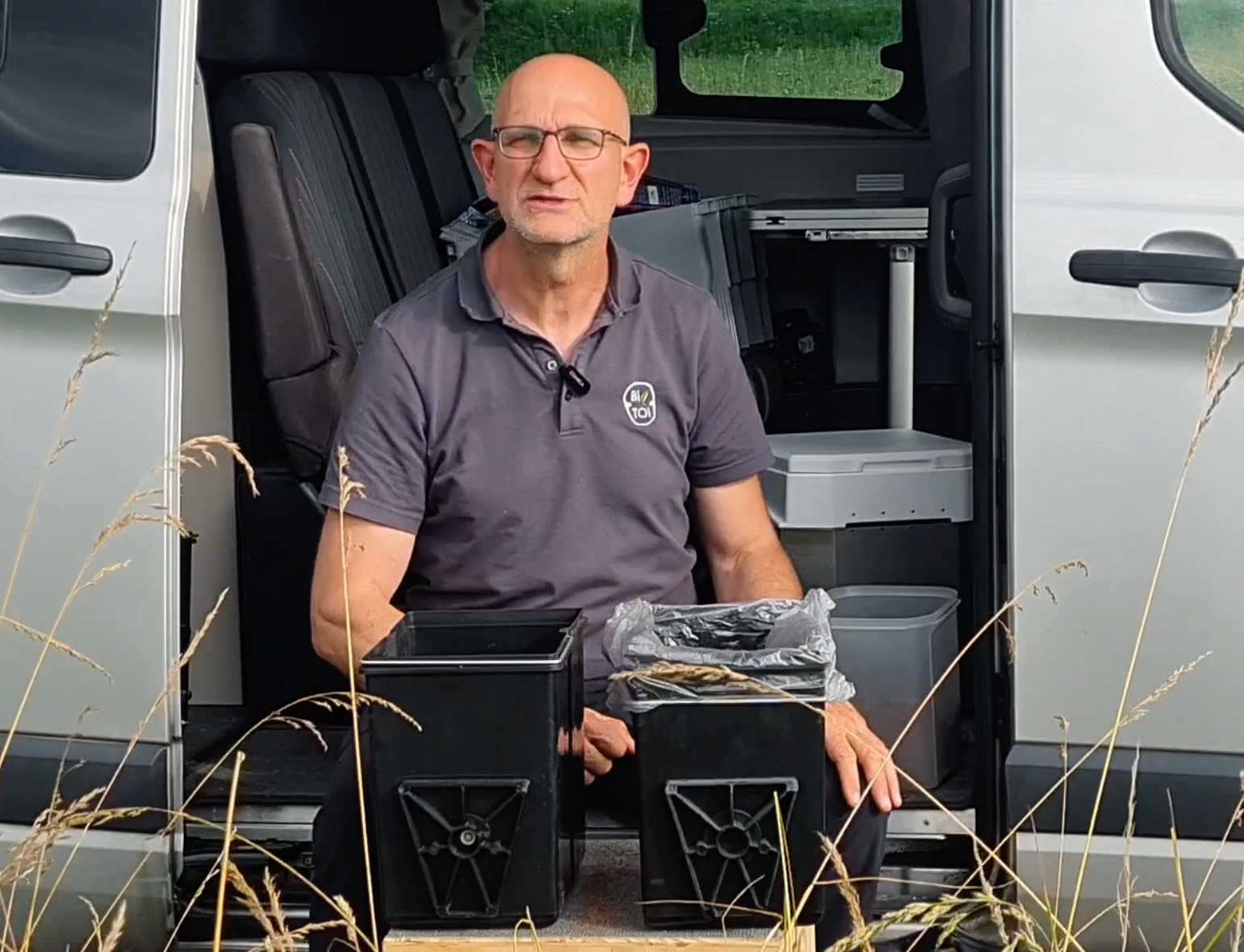
Every BioTioo operates optionally in bag mode or compost mode, in exactly the same housing: The core concept, the only mobile toilet that can be flexibly switched from bag to compost mode. This is made possible by a design decision, not an additional feature: The operating mode is determined by the solid waste container, not the product model.
The operating mode is in the container, not the housing

For most dry toilets, the purchase permanently determines the design: If a stirring mechanism is installed, it permanently blocks any bag; if none is installed, composting is completely excluded. We did not want this limitation because travel plans change faster than toilets. That’s why the BioTioo is modular: All components can be flexibly installed and removed, including the solid waste container itself. With a bag in the container, it runs in bag mode; with a stirring container and coconut fibers, it runs in compost mode—both in the same housing, never both purchased at the same time.
The urine side remains unaffected by this choice. The separation insert, SmellX odor seal, and 10-liter urine tank work identically in both modes; separation at the source prevents contact between urine and solids, so neither mode requires water or chemicals. The basics are explained in how the separating toilet works. The variant codes follow the same logic: B stands for Basic (bag mode), R for Stirrer, L for Fan, M for Motor.
Bag mode: the tool for short phases

In bag mode, a bag collects the solids. After each use, you sprinkle cover material over it, seal the bag at the end, and dispose of it according to local regulations; which cover material is suitable is shown in the cover material comparison. We designed this mode for three situations: for the weekend, because a compost cycle is not worthwhile for two nights; for those who consciously want the more affordable setup, since bag mode works without a stirring mechanism; and for severe illness.
During diarrhea, more moisture enters the container than any drying can promptly handle, which applies to every toilet of this type, with or without a stirrer. Technically, compost mode could still continue, but you would need to monitor the pH value: Diarrhea often shifts stool to a pH of 5.5 or below due to incomplete digestion, noticeably more acidic than usual, which can be counteracted with a balancing agent like lime from traditional composting practice. Therefore, the bag is the simpler tool: At the next stop, you switch to bag mode, and your compost cycle remains clean. The complete procedure is explained in Gastrointestinal on the road and compactly at BioTioo during diarrhea.
As a long-term solution, every bag reaches a physical limit: The longer it remains filled, the more moisture and heat affect it. Therefore, bag mode is a tool for days, not a replacement for the compost variant over weeks.
Compost mode: the mode for long tours

In compost mode, the stirrer mixes the solids with coconut fibers. This causes the contents to dry quickly, pre-composting starts directly in the container, and the result looks like forest soil. One container fill provides 20 to 30 uses, depending on drying intervals; you plan in weeks instead of days and are no longer dependent on disposal stations. How mixing and drying work in detail is explained in the stirrer function; whether a hand crank or motor drives the stirrer is clarified in RL or RL-Motion.
Three points belong to an honest description. Finished compost does not form in the container: Post-composting takes around two years after removal, for example on your own compost heap, provided composting is allowed there. Coconut bricks swell with hot water, which you plan for when packing. And cleaning differs from bag mode: Without a bag, there is nothing to remove and tie off. When emptying, you shake out the solid waste container and put it back in immediately; a residue in the container serves as a compost starter for the next fill, washing out is usually not necessary.
The honest trade-off: plastic waste or coconut supply

Neither operating mode is the cheaper choice in every respect, and that’s exactly why both exist. Bag mode produces a sealed bag with each emptying, which goes into residual waste: a consumable item that repeats with every use. Compost mode produces no bag. The dried contents bound with coconut fibers can be composted, where permitted, without plastic and without consumables at every emptying; shaken out and with a residue as a compost starter, you put the container back in immediately.
Those who use bag mode permanently exchange the smaller consumable of the compost variant for a recurring plastic item in residual waste. Those who use compost mode need a continuous supply of coconut fibers, which must first swell with hot water before use. We do not make this trade-off for you; we build both options into the same housing.
The choice is made on packing day, not on the road
The switch itself takes seconds: You remove the solid waste container with one upward grip, insert the setup of the other operating mode, the housing remains installed, and no tools are needed. You can find the stirrer solid waste container for retrofitting in the separating toilet accessories.
Nevertheless, the decision belongs at the start of the trip, not in the night when it is needed. A half-filled compost container does not spontaneously switch to bag mode; you would have to empty it first, and in an emergency, there is no time or calm for that. Our advice is therefore not a cliché but the only sequence that works in an emergency: Decide on the operating mode before departure and pack the material for plan B. A bag reserve weighs almost nothing and turns an emergency into a short stop at a rest area instead of a conversion in the dark.
Availability
Both operating modes run on every BioTioo 2.0: The B variant starts in bag mode, the RL includes a stirrer and 12-V fan for compost mode, and each can be retrofitted later. You can compare all configurations in the overview of dry separating toilets; the tour through all assemblies is offered in The BioTioo, assembly by assembly. Every BioTioo is developed and manufactured in Überlingen on Lake Constance, with a 3-year warranty on bowl and lid and a 60-day return policy.

