



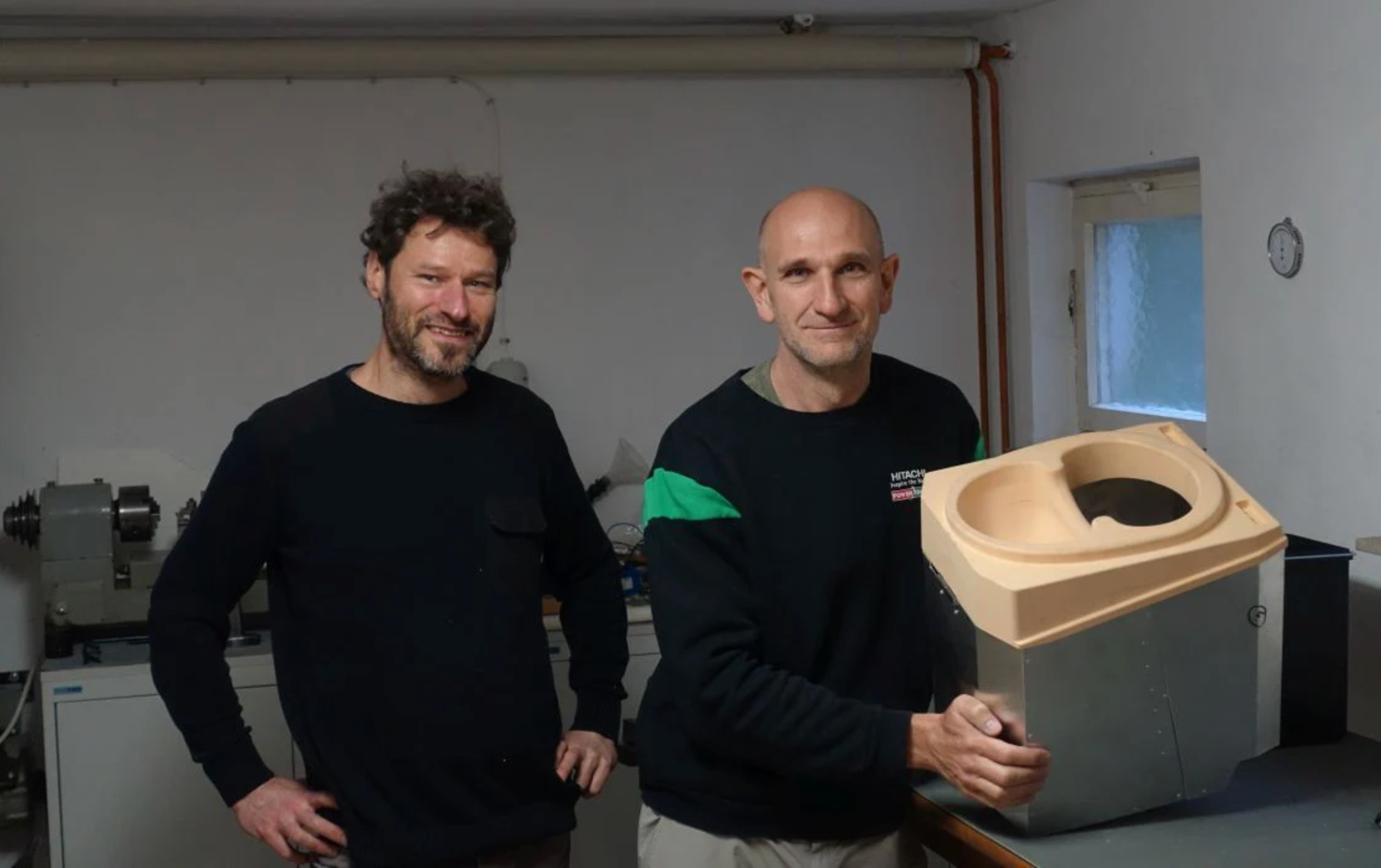
The BioTioo 2.0 weighs 6.5 kilograms, featuring a stainless steel housing, a 10-liter urine tank, and a load capacity of 200 kg. This weight was a design goal, not a side effect. Every fixed kilogram in the vehicle counts twice: it reduces the payload and adds stress to the mounting points with every brake.
Thin-walled stainless steel achieves the weight
We reach the 6.5 kg through two decisions. First, a thin-walled stainless steel housing: the sheet gains its stiffness from bends and rivets, not material thickness. Second, the material mix: the bowl and lid are made from lightweight PP-C instead of metal. This keeps the overall system at 6.5 kg, with external dimensions of 388 × 390 × 332 mm, compact enough for small swivel bathrooms. Why we combine these materials exactly is explained in the factory note Stainless Steel and PP-C.
The payload calculation in a 3.5-ton vehicle
In a 3.5-ton vehicle, payload is the scarcest resource. The toilet is a permanent weight on board and should be included early in the calculation: permissible total weight minus actual weighed weight equals available margin. At 6.5 kg, the BioTioo takes up about as much as a small water container.
The second item is completely eliminated: flushing water. The BioTioo operates water-free and chemical-free. A cassette toilet flushes from its own water supply, and every liter weighs one kilogram, trip after trip. This means we never carry flushing water or sanitary fluids permanently, leaving those kilos free for supplies, tools, and luggage.
The forces on the mounting
The basic formula F = m · a applies to the screws: force equals mass times acceleration. During a full brake, the toilet pulls forward roughly with its own weight, so with a full urine tank about 16 kg (6.5 kg plus 9.9 liters of usable tank volume). Potholes add short-term higher shocks on top. Every kilogram saved relieves each screw with every brake.
More weight initially feels more stable, solid, less wobbly. Physically, the opposite is true: at the same deceleration, more mass creates more force on the mounting, not more stability. A heavier housing doesn’t stand more steadily; it just pulls harder on the same screws.
We have designed the mounting points for these loads. Six holes are prepared in the base support surfaces, plus mounting points on the back wall; floor, wall mounting, or mobile use are possible. You never undo the mounting in daily use: you lift out the solid waste container with one hand, while the housing remains screwed in the vehicle. Answers to the most common mounting questions are gathered in our Installation Check.
The full tank weighs the same for every system
Empty weight doesn’t help when carrying, and we say that clearly. A full 10-liter urine tank weighs just under 10 kg, for us as for any system with the same tank size. The weight advantage applies to payload and mounting, not to the trip to disposal. You can empty earlier; a half-full tank weighs about 5 kg, and you can empty it at any toilet, even at highway rest stops. For fixed installations, the underfloor tank connection directs urine straight into an external tank; then you don’t carry a container at all.
Second honest number: 6.5 kg is not the lowest weight on the market; pure plastic toilets can be lighter. Our weight applies despite the stainless steel housing, 10-liter tank, and 200 kg load capacity. Those who are lighter often pay for it with a significantly smaller tank, requiring more frequent emptying. Weight alone says nothing about capacity. When buying, always compare weight, tank volume, and material together.
Availability
The 6.5 kg applies to every BioTioo 2.0; we manufacture and weigh every component here in Überlingen on Lake Constance. We offer a 3-year warranty on the bowl and lid, plus a 60-day return policy. Suitable models for vehicles are shown in the Motorhome overview.

