



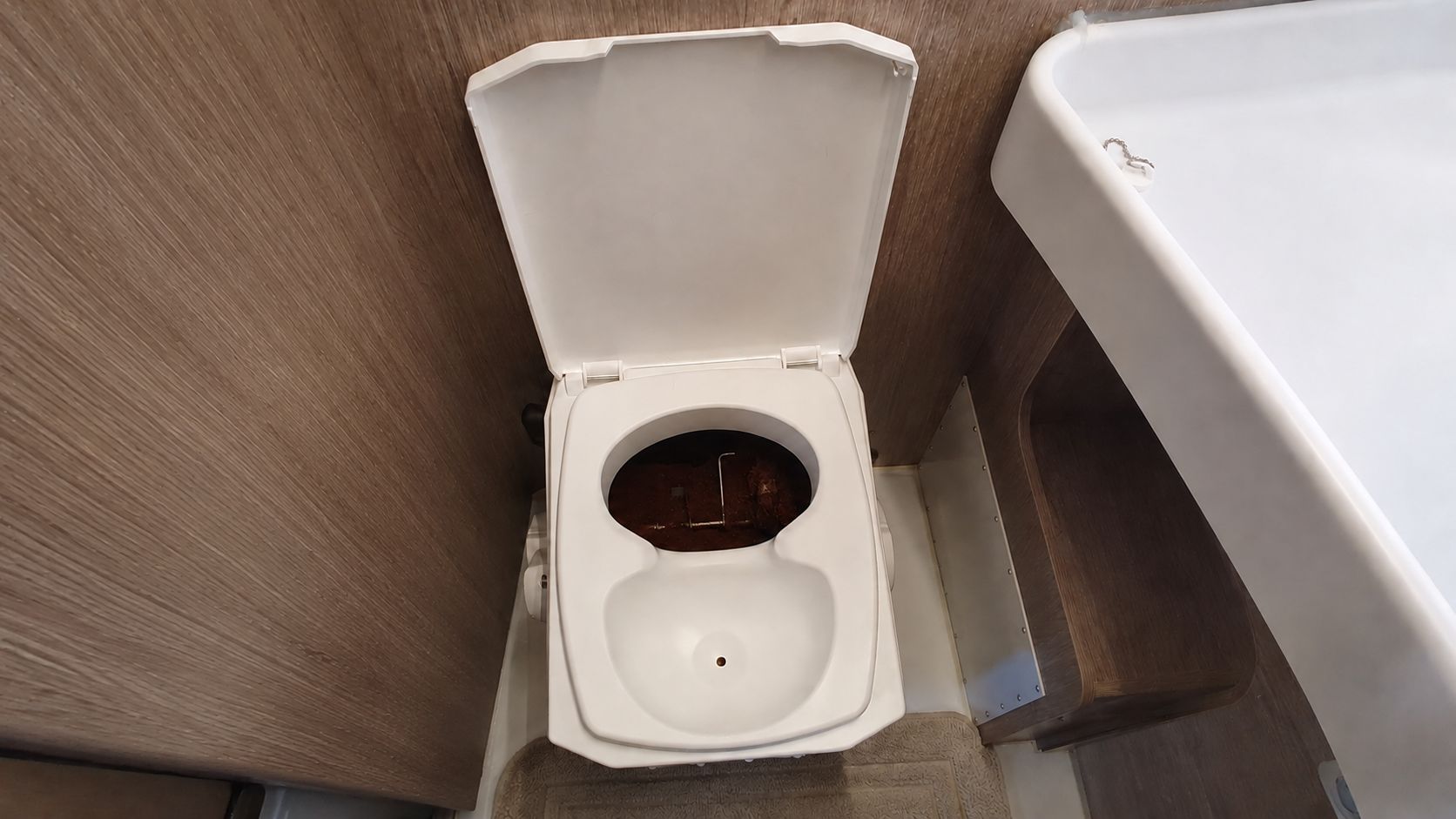
Women who want to sit reliably on a dry separation toilet can only maintain concentration until the third night. What stabilizes the sitting position is not discipline, but geometry: three mechanical adjustment screws in the bowl, namely two integrated bases as physical seat supports, a high separation ridge to prevent backflow, and a generous solid waste opening to avoid precision constraints. In the BioTioo 2.0, these three adjustment screws are coordinated with each other.
This page explains the constructive logic behind it: what the two bases in the seat really do, why a large opening does not lead to more odor, and how the Bowl 2.0 set can be retrofitted into an existing first-generation BioTioo.
How Bowl 2.0 Constructively Solves the Anatomy for Women
Four mechanical adjustment screws determine whether a separation toilet relieves or complicates the sitting position for women. The Bowl 2.0 geometry covers all four.
The Anatomical Requirement for a Separation Insert
The female urethra is significantly shorter at about three to five centimeters than the male urethra, which is about fifteen to twenty centimeters. As a result, the urine stream in women often exits less concentrated when sitting and tends to flow downward and forward. Therefore, in a dry separation toilet, not only the pure separation is crucial but also the ergonomic sitting position to ensure urine reliably reaches the front liquid area and not the solid waste opening. A sanitary research study by Eawag on gender-specific urine separation additionally describes that women have a larger angle range when urinating and that the risk of hitting the wrong compartment systematically increases. This is not a discipline issue but a design requirement for the construction.
The Two Bases as Physical Seat Supports
The two integrated bases in the bowl are not a gimmick but a physical support that reliably holds the pelvis in the same place. You are not sitting on a flat seat ring but on a shaped seat that makes the sitting position reproducible—even when concentration wanes or the sitting posture shifts in a half-sleep state. The distance to the separation ridge remains stable, making the separation predictable.
The High Separation Ridge as a Safety Line for Women and Children
The high separation ridge between the urine area and the solid waste opening is a crucial safety line in a separation toilet. If the ridge is too low or the sitting position is not properly guided, urine can flow into the solid waste area when leaning back slightly, sitting restlessly, or tilting sideways in the camper. That is exactly why in Bowl 2.0 the separation ridge, bowl geometry, and the two Bowl 2.0 bases are coordinated: the bases automatically guide the pelvis into a stable sitting position, while the high separation ridge clearly separates the front liquid area from the solid waste opening.
This combination is a must-have, especially for women and children. Women often sit anatomically closer to the critical separation zone, children have smaller pelvises and tend to slide too far forward on normal toilet bowls. The two bases prevent children from sitting directly on or touching the separation ridge and ensure that urine is reliably directed forward into the liquid area. This makes the separation significantly safer even with smaller body sizes, restless sitting postures, and real camper conditions.
Larger Opening Without Odor Penalty – Why It Works
At first glance, a larger solid waste opening seems risky: more opening, more air space, more odor. In practice, typical toilet odor does not arise because the opening is larger but mainly when urine and solids come together unfavorably, moisture forms, and organic material dries poorly. Therefore, the key is not to make the solid waste opening as small as possible but to cleanly control urine, solids, moisture, and airflow.
That is exactly why the solid waste opening can be generous. A small opening is harder to hit in use, especially in a camper, on a slope, at night, or when children use the toilet. Some campers also report that with narrow openings or sliding systems, residues stick to the edges, flaps, or moving parts. This makes cleaning unpleasant and increases the odor risk exactly where hygiene should be ensured.
Bowl 2.0 solves this differently: the solid waste opening is large enough to reliably hit it in everyday use, while the urine area, separation ridge, bowl geometry, and sitting position support the separation. As a result, less urine misses the target, less residue sticks to the edges, and cleaning remains easier. The stirring mechanism is an additional safety level: small amounts of urine that still end up in the solid waste area due to half-sleep, tilt, or restless sitting are absorbed, distributed, and dried faster with coconut fibers. This keeps the solid waste area dry enough to prevent unpleasant odors in the living space.
Ammonia is not the main reason why a larger solid waste opening would be problematic. Ammonia mainly forms when urine is bacterially decomposed over time; it becomes critical especially with standing, moist, or poorly sealed urine flow. This issue is not solved by a smaller solid waste opening but by clean urine separation, a functioning odor trap in the urine area, and as little moisture as possible in the solid waste area.
What This Means in Everyday Life – Error Tolerance, Three Schools, Half-Sleep
The constructive depth of Bowl 2.0 pays off in three everyday dimensions.
Three Dimensions of Error Tolerance: Fatigue, Guests, Life Phases
Constructive error tolerance means three concrete things in everyday life:
- Fatigue tolerance: The toilet copes with half-sleep and concentration fluctuations, not just focused sitting at noon.
- Guest suitability: Those who share the camper with friends, children, or family give the guest a thirty-second briefing instead of a sitting training.
- Life phase stability: During menstruation, old age, limited mobility, or with a growing belly in late pregnancy, the separation performance remains intact.
When these three dimensions come together, the construction is good. If only one or two apply, it is acceptable.
Where Bowl 2.0 Stands in the Market’s Three-School Model
Three construction schools are emerging in the market: School 1 relies on precise aiming with a narrow separation edge, School 2 on a flap mechanism that mechanically redirects aiming, and School 3 on mixing in the container plus a generous opening. Bowl 2.0 clearly belongs to School 3—it forgives separation errors through base stabilization, a high separation ridge, generous opening, and stirring mechanism tolerance. The complete three-school comparison with strengths, weaknesses, and women’s notes table is available in the hub on Sitting Position as a Woman on the Separation Toilet.
Half-Sleep Connection: Short Because the Depth Is Located Elsewhere
The nighttime half-sleep question is a special case and gets its own answer: three behavioral levers, three construction levers, and a morning cleaning step. This seven-point solution is explained in the guide Dry Separation Toilet at Night for Women.
How Bowl 2.0 Is Implemented in the BioTioo Models
Two BioTioo models share the Bowl 2.0 set; a retrofit path also opens the setup for older 1.0-generation toilets.
The Bowl 2.0 Components: Two Bases, High Separation Ridge, Generous Opening, Polypropylene PP-C
Bowl 2.0 is made of UV-resistant polypropylene PP-C, a material that remains impact-resistant even in cold and does not yellow or become brittle under sunlight in the camper bathroom. The two integrated bases in the seat hold the pelvis in a reproducible position, the separation ridge is raised, and the solid waste opening is generously sized. The housing around it is made of stainless steel V2A, screwed and riveted—no gluing, no plastic connections that give way after years.
RL or RL-M? The Bowl Is Identical, the Drive Decides
Both models, the BioTioo 2.0 RL with hand crank and the BioTioo 2.0 RL-M with TiooMotion motor, share exactly the same bowl and the same separation insert with two-base seat. What differs is only how the stirring mechanism is driven: by hand or by motor with day/night mode, child lock, and hybrid crank backup. The seat geometry is the same in both—the choice between RL and RL-M is therefore a drive question, not a seat question.
Retrofitting: How Bowl 2.0 Fits into a 1.0 Housing
Those who own a first-generation BioTioo can upgrade to the Bowl 2.0 set—the external dimensions are identical between generations. You swap the bowl and separation insert for the 2.0 version; the housing remains. Additionally, the SmellX odor trap and the LV-3 fan can be retrofitted separately. This makes BioTioo modular: existing customers do not have to buy new; they can gradually upgrade to the current standard.
Trust: Warranty, EIA 2021, Made in Germany
There is a three-year warranty on the bowl and lid. The toilet was awarded the European Innovation Award in 2021 in the Sustainability category. It is developed and produced in Überlingen on Lake Constance, Made in Germany, with a short supply chain and service with consultation options by phone.

