



In everyday travel, a dry separation toilet for women decides on three things that often run in the background in a stationary bathroom: intimate hygiene without running water, hygiene waste until the next trash can, and discretion during tank transport. For solo travelers, an additional safety issue arises that no one likes to openly discuss.
UNICEF and WHO state in their guidelines on Menstrual Health a sentence that surprisingly well describes van life daily life: women need space, privacy, and time, and the further they travel, the more they need. A dry separation toilet in the camper is therefore less of an eco-argument and more a dignity argument, less comfort and more control over one's own intimate space.
What is different in the motorhome compared to home – mechanics of travel hygiene and discretion
Four small tools determine how naturally hygiene and tank transport work on the road.
The intimate shower: the smallest tool with the greatest effect
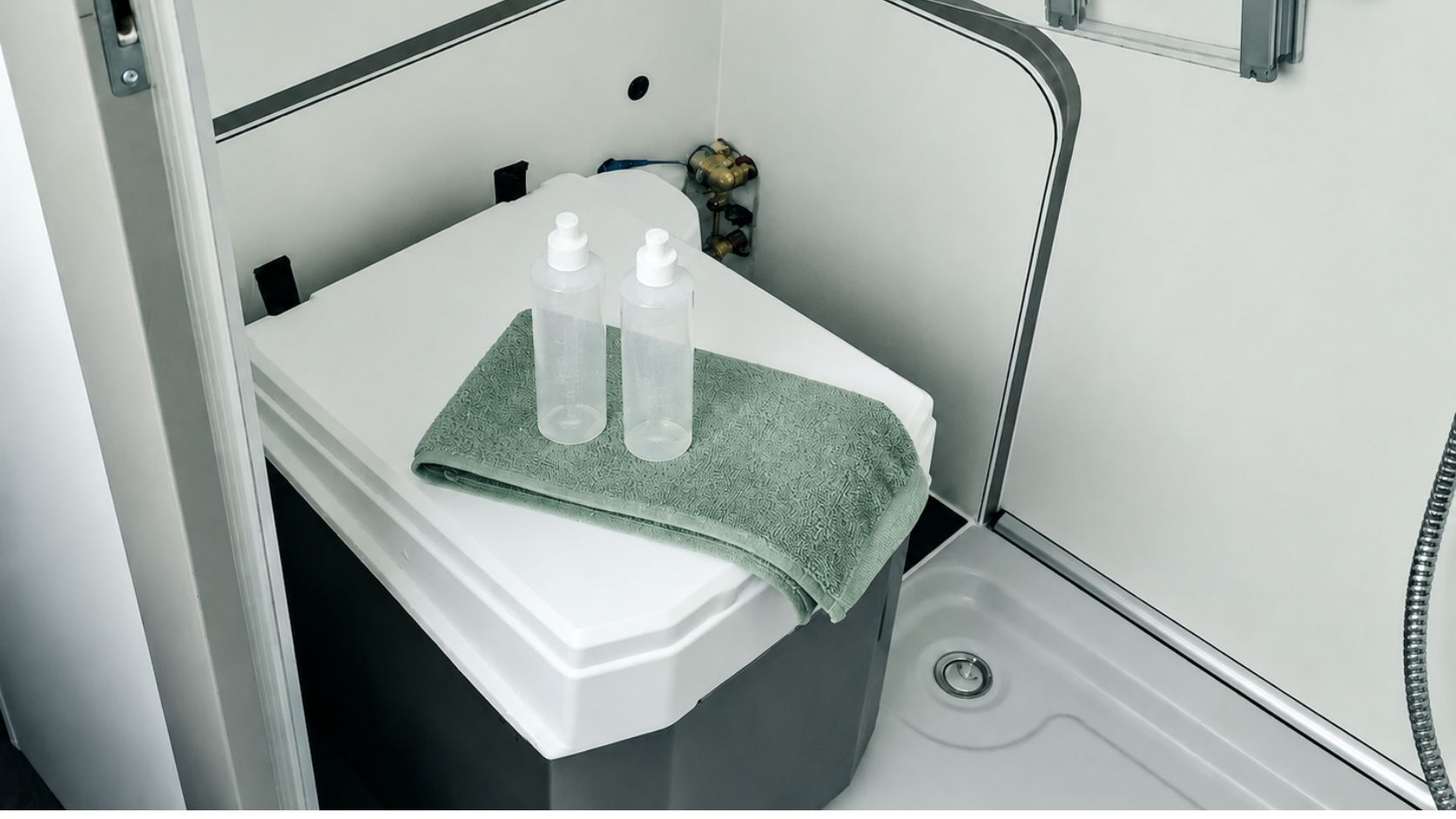
An intimate shower is a simple squeeze bottle with a narrow spout. Most women receive it after childbirth for gentle cleaning of the intimate area, and this exact idea has been adopted by the international van life community. In the camper, the principle works with a few pumps of lukewarm water and replaces much of the faucet washing situations that simply are not available on the road.
The waterproof storage bag: why dog waste bags alone are not enough
Tampons, pads, and used toilet paper need an odor-tight intermediate storage until disposal. Thin plastic bags (e.g., dog waste bags) seal only to a limited extent and can let odors through after hours; therefore, reusable storage bags with waterproof inner coating (e.g., PUL) and secure closure are recommended. Such bags are washable, discreet, and significantly more effective in everyday use than simple bags.
Why wet wipes are not a permanent solution on the road
Wet wipes are suitable as an occasional emergency solution but are not recommended for daily use: frequent use can irritate the skin or disturb the natural skin flora, especially in heat or with sensitive skin. In separation toilets with solid waste containers, wet wipes should generally not enter the solid waste container because they bind moisture, disrupt the drying process, and do not always decompose; they belong in the residual waste instead. In single-use systems (bag solutions), wet wipes can technically be disposed of in the bag but make the bag wetter and increase odor and disposal effort. In actively pre-composting compost toilets with suitable disposal concepts, disposing of wet wipes in the solid waste container is unsuitable because wet wipes are usually not biodegradable and do not properly pre-compost. Additionally, there is a risk that they can wrap around the spindle. Alternative hygiene measures are recommended: dry toilet paper plus possibly a small bottle of mild water/soap spray for cleaning or reusable, washable wet wipe alternatives.
How the urine tank stays discreet – what the SmellX closure achieves
The wide-neck urine tank has a screw cap and closes completely. The patented SmellX odor seal additionally prevents any smell during transport in the bag – a floating ball instead of a rubber membrane that remains airtight even when tilted in the bag. A closed lid is also possible. This way, the tank fits closed into any shopping bag or backpack and looks inconspicuous from the outside.
Travel routine: hygiene kit, emptying urine tank, solo travel, period on the road
Four tools become a routine that runs reflexively after two travel days.
The travel hygiene kit in five parts
Five components are enough for a week-long trip. They all fit into a small basket or bag under the sink:
- Intimate shower filled with water: replaces the faucet for intimate cleaning.
- Spray bottle with vinegar solution 1:7 for the separation insert after each use; dissolves urine scale, keeps the seat hygienic.
- Waterproof storage bag as an odor-tight intermediate storage for tampons, pads, and used toilet paper until the next trash can; from the cloth diaper sector, not from the camping shelf.
- Wet wipes as an emergency for situations without water, not for daily routine.
- Household toilet paper, on the road just like at home.
The whole kit costs a few euros and fits in any corner.
Emptying the urine tank discreetly – five steps
The routine at a rest stop is simple and stable:
- Remove the tank with SmellX closure or a closed lid and place it in a shopping bag.
- Walk to the public toilet – no one asks, no one looks.
- Unscrew the lid in the cabin and empty the tank into the toilet bowl, flush with water afterwards.
- Rinse the tank and odor seal with water and some dish soap.
- Put the tank back into the bag, screw it back onto the camper, done.
This works at rest stops, city center toilets, campsites, and supermarket toilets alike.
When you travel alone – what changes in safety and rhythm
Solo travel is not like traveling with a partner. Three things work differently, and the most important difference is safety. Those who park alone rarely stand where illuminated sanitary buildings are located. Walking at night over unknown terrain to a foreign cabin makes many women prefer to postpone or skip the trip altogether. The scoping review literature on female toilet behavior describes exactly this pattern: postponement, hovering, changed behavior in unfamiliar surroundings. With a separation toilet in the van, this decision is eliminated. You stay inside, in your own space, with the door locked. This is not just comfort; this is safety. And: solo travel means half the consumption. The emptying interval doubles mathematically; three weeks without solid waste emptying is plausible.
Period on the road: the travel emergency plan
During the trip, the cup logistics from the period guide apply; what changes are the travel-specific steps. Empty the menstrual cup in the urine tank or in the solid waste with a bit more coconut fiber, tampons and pads in the waterproof storage bag, into the residual waste at the next stop. If the period starts unexpectedly: every drugstore has pads, every supermarket tampons; you can also get a cup afterwards and use it the next day. The full cup methodology and the tampon disagreement table are explained in the guide on Period and separation toilet.
If you need to go more often at night (preview)
During menopause or nocturia, the safety aspect counts twice at night. The seven-point solution and night mode are explained in the guide Separation toilet at night for women.
What BioTioo specifically offers women on the road
Four points make the BioTioo 2.0 RL a practical travel companion: three standard components plus an add-on specifically for discretion.
The lid: opaque tank transport as a discretion add-on
The BioTioo lid is an add-on for about 5 euros that noticeably relaxes tank transport in everyday travel, especially for women traveling alone. It closes opaquely over the urine tank, completely covers the contents, is available in red, and has established itself as a standard for discretion without you having to change the entire tank.
SmellX and the 10-liter tank: tilt and three-day range
The patented SmellX odor seal with floating ball technology remains tight even with a bag – tilt does not bother it. The 10-liter urine tank in DIN-96 wide-neck format is removed from the top inside and lasts two to three days for two people; solo travel means half the consumption, i.e., up to six days between stops. This allows travel logistics to be planned without having to count every second rest stop as a mandatory stop.
6.5 kilograms: why this matters for solo travelers
The entire toilet weighs 6.5 kilograms with dimensions of 388 × 390 × 332 millimeters. You can easily lift it alone from the camper into the awning or a garden shed – a practical point especially for solo travelers with an awning setup or for garden hut use.
RL or RL-M on the road? A short decision rule
If you don't want a 12V continuous power supply, the RL is a good choice – complete autonomy, hand crank, the same SmellX and the same Bowl 2.0 set as the RL-M. The RL-M is worthwhile if you regularly take longer tours and want the comfort of automatic night stirring plus night mode.

